
Custom Filters for Controlled Environments
Replacing an existing brand or model? Start with the original part number, exact dimensions, seal arrangement, airflow and operating conditions. CleanroomLink helps procurement teams, engineers and compliance managers source custom cleanroom filters that match fit, form and function.
Replacement-first sourcing
- 01Match the housing: W × H × D, frame construction and installation depth.
- 02Match the performance: efficiency class, rated airflow and pressure-drop limits.
- 03Match the environment: seal type, temperature, humidity and chemical exposure.
- 04Confirm documentation: leak-test method, test report requirements and applicable standards.
Fast RFQ Guide
Give us the details that determine compatibility.
The original manufacturer part number is the fastest starting point for a replacement quote. For a new system, provide the operating data below so a Custom Filters manufacturer can review the specification before pricing.
Start an RFQEfficiency class
H13, H14, U15 or U16 per EN 1822 / ISO 29463, as applicable.
Exact dimensions
Provide frame width, height and depth, plus drawing tolerances where available.
Airflow requirement
Rated flow in m³/h or CFM, along with the system pressure-drop limit.
Sealing and environment
Gel, PU gasket or knife edge; temperature, humidity and chemical exposure.
Information We Need
Build the filter around the system, not only the filter face.
A replacement must fit the housing and preserve the intended airflow. Send a nameplate photo, previous test report, product drawing or installation image when available. These references help us verify the fit, form and function of an alternative before production.
Efficiency, resistance and airflow are connected.
Higher efficiency or denser media can increase resistance. If initial pressure drop rises, the existing fan may deliver less airflow or require more power. We therefore review the rated airflow, initial resistance and recommended final resistance together.
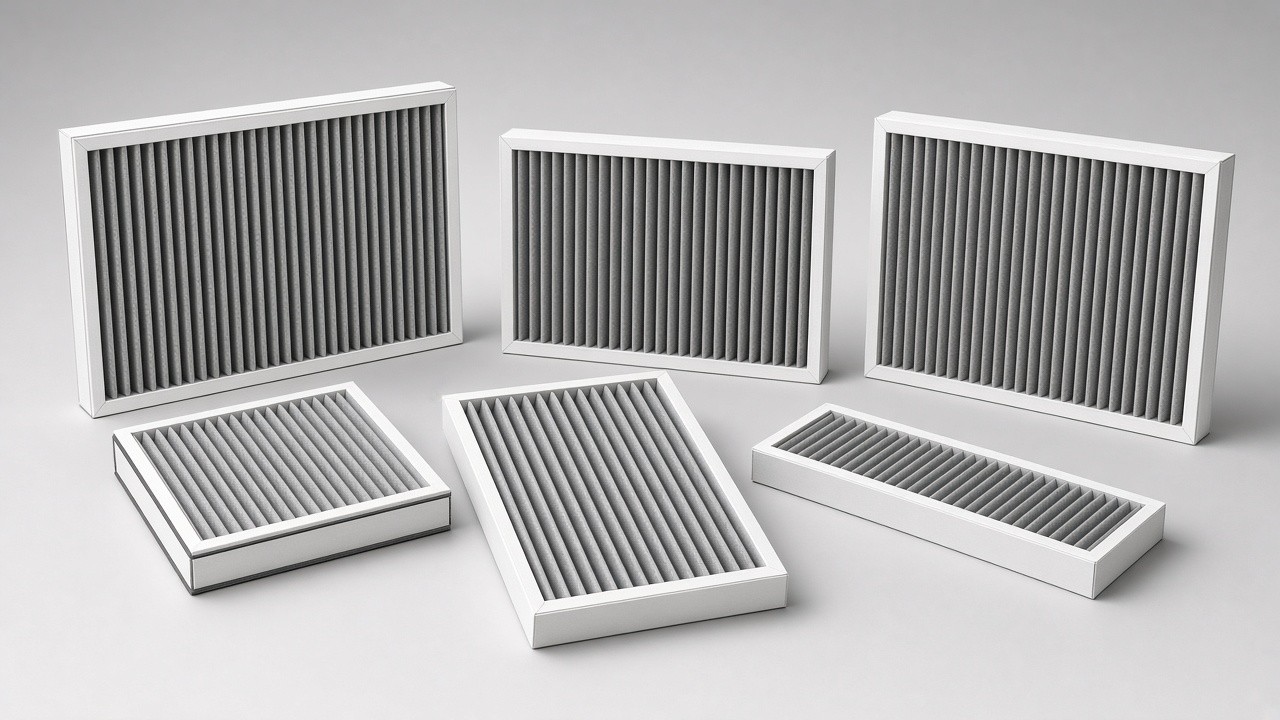
Product Structure
The construction details behind a custom cleanroom filter.
Configurations may use mini-pleat construction with hot-melt separators for consistent pleat spacing, or separator construction with aluminum foil separators where additional structural integrity is needed. Media, frame, seal and test requirements are selected as one system.
Media
Fiberglass or PTFE
PTFE membrane options can support low-resistance and chemically demanding applications. Fiberglass remains a widely used option for high-efficiency filtration.
Frame
Built for the housing
Anodized aluminum, stainless steel or galvanized steel frames may be selected according to corrosion exposure, strength and installation requirements.
Seal and testing
Close the installation risk
PU gel, closed-cell EPDM, silicone gasket or knife-edge arrangements can be reviewed with PAO or DOP scanning requirements.
Parameter Table
Specification fields for technical review.
Values marked for confirmation should be finalized during the RFQ stage against the housing, fan curve and validation protocol.
| Parameter | Specification options / RFQ status |
|---|---|
| Filtration grade | H13, H14, U15, U16; EN 1822 / ISO 29463 applicability to be confirmed |
| Filtration efficiency | Depends on model and grade; target efficiency to be confirmed |
| Rated airflow | Custom per application requirement; m³/h or CFM to be confirmed |
| Initial pressure drop | Depends on media, pleat density and rated airflow |
| Recommended final pressure drop | Typically assessed against initial pressure drop; confirm for the selected model |
| Filter media | Glass fiber or PTFE membrane; selection to be confirmed |
| Frame material | Anodized aluminum, stainless steel or galvanized steel |
| Dimensions | Custom W × H × D; exact housing dimensions and tolerances required |
| Sealing method | PU gel, closed-cell EPDM, silicone gasket or knife edge |
| Temperature / humidity resistance | Standard fiberglass configuration up to 80°C and below 90% RH; PTFE configurations up to 100% RH; confirm application conditions |
| Dust holding capacity | Depends on media, pleat design and operating conditions; available on request |
| Leak-test method | PAO or DOP scanning; report availability and protocol to be confirmed |
| Applicable system | Cleanroom ceiling grids, wall-mounted modules and HVAC-integrated systems; compatibility to be confirmed |
Typical Configurations
Choose by airflow, environment and validation level.
01 / Low resistance
Mini-pleat filters
Hot-melt separators maintain uniform pleat spacing and can support applications seeking low pressure drop and high dust holding capacity.
02 / Structural strength
Separator filters
Aluminum foil separators can be considered for higher-temperature or higher-humidity environments where structural stability is important.
03 / Sensitive processes
PTFE media
PTFE membrane options may suit semiconductor and advanced electronics manufacturing where chemical resistance and outgassing concerns influence selection.
Selection boundary: do not change media without checking the fan curve.
A high-density fiberglass alternative may increase resistance in a high-volume, low-pressure system. Recalculate fan power and verify delivered airflow before approving a substitution.
Lead-Time Drivers
Plan delivery around the parts that need review.
A Custom Filters supplier should make timing visible before purchase approval. We provide a configuration-based estimate during the RFQ process.
Testing protocol
Individual leak testing and requested reports add review time but support controlled-environment acceptance.
Media availability
PTFE and high-temperature glass fiber may require longer procurement cycles than standard H13 fiberglass.
Custom frame fabrication
Standard sizes may be available from inventory, while non-standard dimensions require frame production and tolerance review.
Custom Options
A sourcing path for standard, GMP and replacement projects.
Standard industrial
Cost-optimized configurations for general manufacturing, with GB/T 13554 requirements reviewed where relevant.
High-compliance supply
For GMP, pharmaceutical and medical device environments, individual test certificates and EN 1822 / ISO 29463 documentation can be requested and confirmed.
Non-standard dimensions
Custom frames can be coordinated to equipment dimensions and tolerances, helping reduce costly HVAC housing modifications.
Frequently Asked Questions
Answers for engineering and procurement teams.
How do we choose between PTFE and fiberglass media?
Review the required efficiency, pressure drop, chemical exposure, humidity, temperature and process sensitivity together. PTFE may offer lower resistance and stronger chemical resistance, while fiberglass can be suitable for established high-efficiency systems. Final selection is to be confirmed from the system data.
What is the trade-off between gel seal and gasket seal?
Gel seals are commonly considered for airtight ceiling-grid installations in demanding cleanrooms. PU, EPDM or silicone gaskets may suit wall-mounted or HVAC-integrated modules. The housing design and maintenance method should determine the final seal.
What storage conditions should be used?
Keep filters in their original packaging in a dry, dust-free environment, ideally at 10–30°C, until installation. Protect the media and seals from impact, moisture and contamination.
How is service life estimated?
Life depends on dust loading, operating hours, airflow, humidity and the system’s final pressure-drop limit. Use measured resistance and the approved maintenance procedure rather than a generic calendar interval.
Can we validate a replacement before a full order?
Sample availability is available on request. Provide the original part number or drawing so fit, seal, airflow and test documentation can be reviewed before production release.
Are third-party test reports available?
Factory test reports and requested documentation can be reviewed during the RFQ. Availability depends on the selected model, test protocol and compliance requirement.
Send RFQ
Ask for Technical Datasheet & Pricing
Send your replacement part number, drawing or required specifications. CleanroomLink will review compatibility, identify the key parameters still to be confirmed and return a configuration-based quotation.
Email:
Address: