
Cleanroom airflow integration for controlled production
Laminar Flow Units for Controlled Production Environments
CleanroomLink connects overseas buyers with industrial-grade laminar flow units for localized particle control, unidirectional airflow, and clean production zones across pharmaceutical, electronics, and precision manufacturing facilities.
Quick Selection Snapshot
Start with the operating requirement
- Primary function
- Localized contamination control
- Airflow options
- Vertical or horizontal
- Filtration
- HEPA or ULPA
- Construction
- Stainless or powder-coated steel
Typical environments include pharmaceutical filling lines and semiconductor or sterile medical device assembly.
Buyer Questions
What should a buyer confirm before selecting a unit?
The right laminar flow unit depends on the clean zone, product exposure, room interface, and target market documentation. A practical RFQ should establish the airflow direction, usable work area, filtration level, control method, and integration constraints before comparing supplier prices.
Where is protection needed?
Define whether the unit protects an open product, a component, a filling operation, or a complete workstation.
How will it connect?
Confirm ceiling height, floor footprint, HVAC interaction, room pressure requirements, and personnel ergonomics.
Which standard applies?
State the required ISO classification, GMP expectations, regional standards, and any CE or market-specific documentation.
What must be verified?
Request filter test reports, leakage results, velocity uniformity data, packaging details, and export documents where applicable.
Short Answers
A focused clean zone, engineered around your process
Unidirectional coverage
Filtered air moves in a uniform parallel stream to sweep particles away from critical work areas and reduce cross-contamination risk.
Modular clean construction
Ceiling-mounted and floor-standing formats can be configured around production footprints, operator access, and existing facility constraints.
Controlled performance
Adjustable air velocity, HEPA or ULPA filtration, and FFU-based control support a balance between work-zone cleanliness and energy use.
Parameter Table
Laminar flow unit specifications for RFQ review
The following options frame the integration discussion. Final values, drawings, test criteria, and compatibility requirements are confirmed during technical verification.
| Parameter | Specification options / RFQ status |
|---|---|
| Equipment type | Ceiling-mounted or floor-standing; depends on model |
| Airflow form | Vertical or horizontal laminar flow |
| Work area size | Custom-engineered to production footprint |
| Cleanliness class | ISO Class 5 to ISO Class 8; final class to be confirmed |
| Filter grade | HEPA H13/H14 or ULPA U15/U16, subject to application |
| Air velocity range | 0.3 m/s–0.5 m/s, adjustable within the stated ±20% range; profile to be verified |
| Air volume | Depends on model, filter pressure drop, and work area; to be confirmed in RFQ |
| Noise | Less than 60 dB(A) at 1 m where applicable; final test point to be confirmed |
| Illumination | Available on request; target level and test method to be confirmed |
| Power supply | 220 V/50 Hz or 110 V/60 Hz; customizable by market |
| Cabinet material | SUS304 stainless steel or powder-coated cold-rolled steel |
| Control method | PLC-integrated control or manual variable frequency drive |
| Customization | Dimensions, airflow direction, controls, integration, documentation, and other options available on request |
Performance data such as velocity profiles, pressure drop ratings, leakage results, illumination, and airflow volume are confirmed during the technical verification phase of your RFQ.
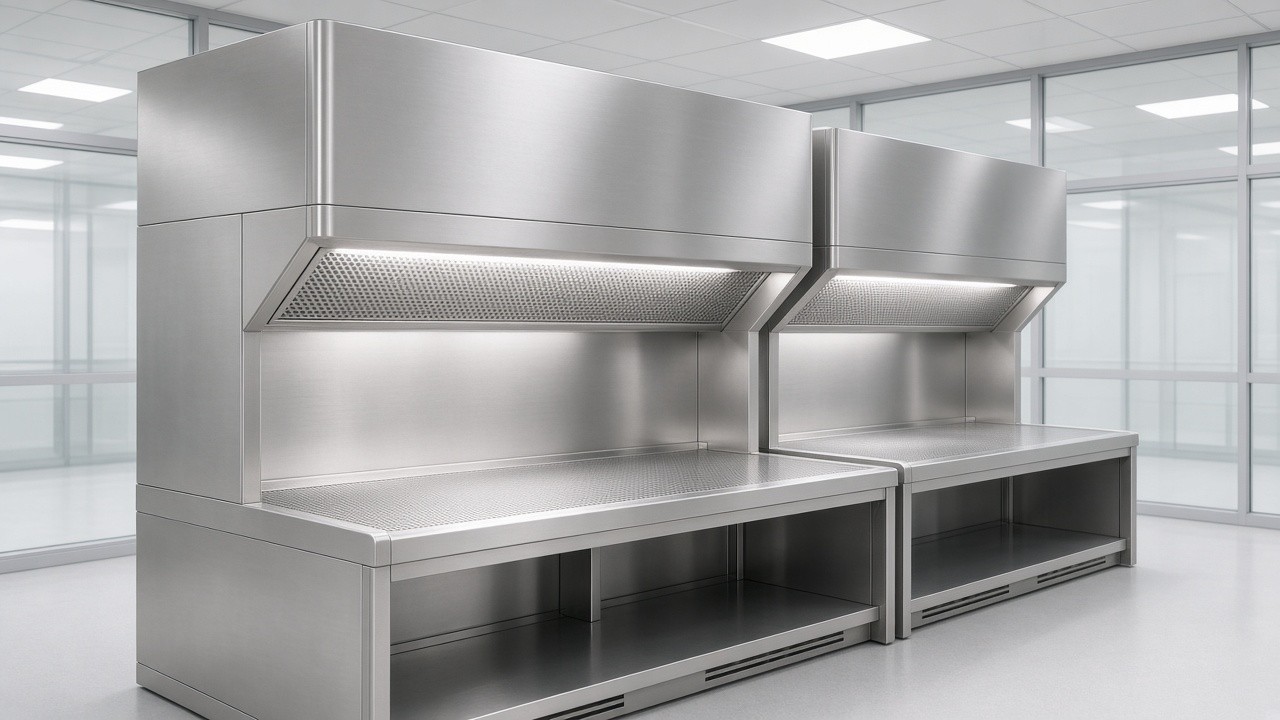
Deep-Dive Specifications
Airflow organization is a facility integration task
A laminar flow unit is not selected by filter grade alone. Our approach evaluates how the unit interacts with the existing HVAC system, room pressure differential, operator position, product exposure, and available ceiling or floor space.
High-efficiency fan filter units support precise velocity control, allowing the clean zone to be tuned for the process instead of operated at a fixed setting. This can help balance particle control, operator comfort, noise, and energy consumption.
Coverage planning
Match module dimensions to the critical work zone.
Velocity uniformity
Confirm profiles and measurement points during testing.
Facility interface
Review HVAC, room pressure, power, and installation access.
Documentation
Align records with the destination market and process.
Use-Case Examples
Localized clean zones for sensitive operations
Pharmaceutical filling lines
Protect open vials and exposed product during filling and capping operations with a controlled unidirectional airflow zone.
Process protection
Electronics and semiconductor assembly
Create micro-environments for wafer handling, PCB inspection, and delicate component work where particles can contribute to defects.
Precision assembly
Medical device manufacturing
Establish clean workstations for implant, surgical tool, and sterile medical device assembly within the required facility strategy.
Controlled packaging
Selection Boundary
Laminar flow units versus air showers
These systems may appear together in a cleanroom project, but they solve different contamination-control problems.
Laminar flow unit
A process-protection tool that maintains a clean zone during operation and directs filtered air across the critical work area.
Air shower
A personnel-decontamination tool used during transition into a cleanroom, not as a replacement for process protection.
What to Verify Before Ordering
Build a complete verification package
A professional Laminar Flow Units manufacturer or supplier should be able to map the commercial proposal to measurable technical and export requirements.
Filter documentation
Request HEPA or ULPA test reports and confirm the selected grade, pressure drop, and replacement approach.
Airflow performance
Confirm leakage testing, velocity uniformity, airflow volume, measurement locations, and acceptance criteria.
Standards alignment
Define ISO 14644 expectations and any applicable EN, ASTM, GB, GMP, or CE documentation for the destination market.
Batch consistency
For wholesale or repeat orders, agree on approved drawings, bill of materials, controls, inspection records, and change notification.
Frequently Asked Questions
Answers for engineering, quality, and procurement teams
Which standards and certifications can be supported?
Units are designed around ISO 14644 and relevant regional requirements such as EN, ASTM, or GB. CE alignment and other certification documentation depend on the final configuration and target market and must be confirmed during the RFQ.
Can you provide filter and performance test reports?
Test reports for HEPA or ULPA filters, leakage testing, and air velocity uniformity can be included where applicable. Required test scope, format, and acceptance limits should be specified before production.
How is consistency managed for repeat or batch orders?
For distributors and long-term buyers, approved specifications, drawings, control systems, materials, inspection points, and change-control expectations can be established before the first batch.
What packaging and export documents are available?
Packaging requirements and export document sets are available on request. Confirm destination, shipping method, labeling, packing list, commercial invoice, and any market-specific documents during quotation.
Can units fit existing floor layouts and ceiling heights?
Yes. Modular configurations can be adapted to existing floor space, ceiling constraints, operator access, and production footprints, subject to technical review.
What is the lead time for custom units?
Lead time depends on customization, quantity, component selection, testing, and certification requirements. A precise schedule is provided after the specification package is reviewed.
Quote Preparation
Request Batch Pricing
For manufacturers, distributors, and engineering contractors, CleanroomLink supports competitive batch pricing and OEM supply discussions for consistent equipment fleets.
To receive a useful quotation, share the required airflow direction, work area dimensions, cleanliness class, filter grade, quantity, power standard, installation environment, target market, and documentation requirements.
Email:
Address:
Send your project requirements
Include your required standards, testing scope, packaging needs, and expected annual or batch volume.