Food processing sourcing and compliance support
Disposable Food Processing Protective Clothing for Controlled Hygiene
When a procurement manager is comparing several suppliers, the lowest quoted price is only one part of the decision. Material safety, production-zone control, documentation, and reliable supply all affect the real cost of protective clothing.
Start with three checks
-
1
Food-contact safety
Confirm the available Declaration of Compliance and the regulations relevant to your market.
-
2
Barrier versus comfort
Balance fabric weight, breathability, liquid resistance, and tear performance for each zone.
-
3
Traceable supply
Request consistent manufacturing controls and batch-level documentation for audits.
Alternative sourcing
A technical alternative to high-cost branded PPE
CleanroomLink helps food manufacturers evaluate disposable protective clothing against the performance requirements that actually matter on the production floor. The objective is not to remove necessary protection, but to avoid paying for specifications that do not improve a particular hygiene zone.
Performance-led sourcing
Compare liquid resistance, tear strength, contamination control, and wear comfort.
Controlled cost structure
Review standard and upgraded options without unnecessary brand overhead.
Match an existing product
Replace a current line without rewriting your SOPs
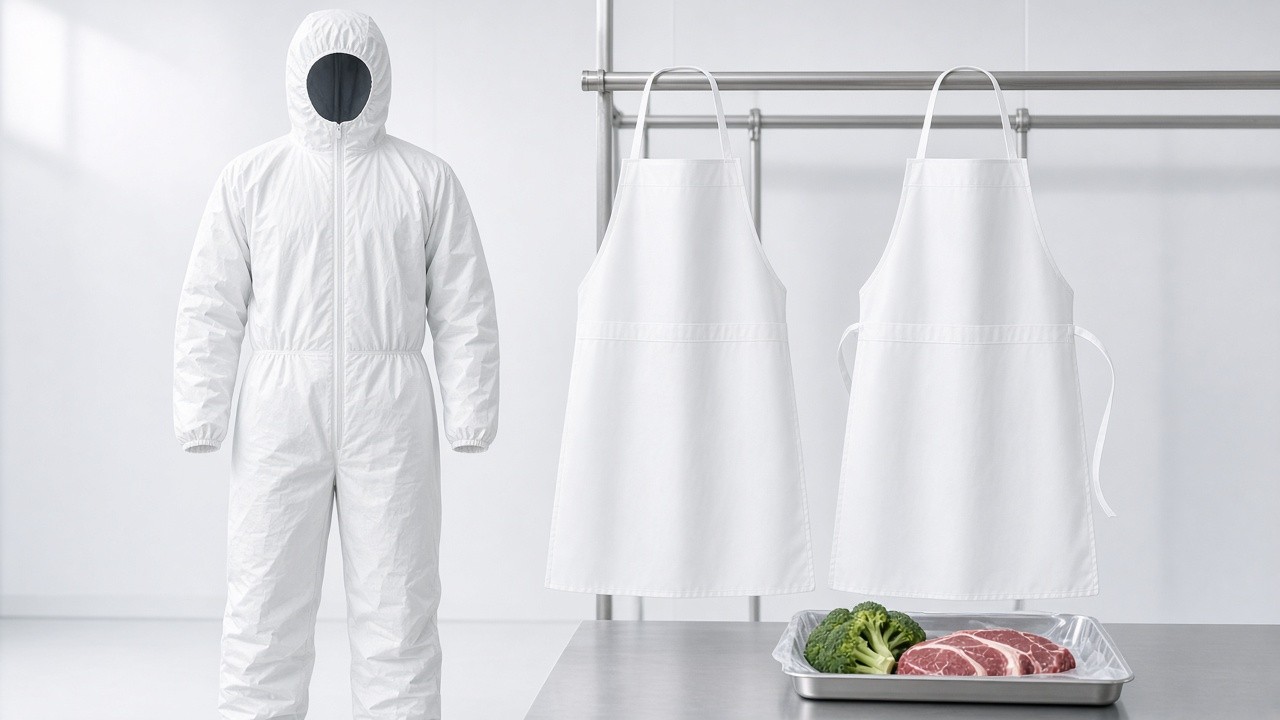
If you already use a disposable coverall, gown, sleeve, shoe cover, or related protective garment, share the technical data sheet or a sample. Our team can review the material composition, garment construction, sizing, packaging, and barrier expectations before recommending a technically equivalent or improved option.
Map the current item
Review the TDS, sample, current use zone, consumption, and acceptance criteria.
Identify the right construction
Compare PP, SMS, microporous, and PE-coated options against the risk assessment.
Validate before scale-up
Test fit, comfort, performance, color zoning, and documents before bulk procurement.
Procurement specifications
Parameter table for disposable food processing protective clothing
These are the fields to define during supplier comparison. Final values depend on the product model, facility risk assessment, local requirements, and the RFQ scope.
| Parameter | Specification options / RFQ status |
|---|---|
| Material | PP, SMS, microporous, or PE-coated; depends on model. |
| Food-contact suitability | EU 10/2011, FDA, GB 4806, or another applicable requirement; to be confirmed for the selected model. |
| Size / sizing | S–4XL options are available; custom sizing available on request. |
| Fabric thickness / weight | 30–65 gsm range indicated by model; exact value to be confirmed in the RFQ. |
| Color | White, blue, green, or custom color options for hygiene-zone management. |
| Use type | Single-use disposable product. |
| Slip / water performance | Hydrophobic or impermeable options; anti-slip requirements depend on the garment component and application. |
| Hygiene attributes | Color-coded zoning, contamination control, and construction aligned with the facility hygiene plan. |
| Packaging | Bulk or individually wrapped; packaging configuration to be confirmed. |
| Processing application | Raw material areas, high-care zones, finished-product handling, sanitation, or other defined operations. |
| Standards / declarations | ISO 13997, EN 14126, CE, GB, ASTM, BRCGS, or FSSC 22000 support as required; availability to be confirmed. |
Selection boundary
Equivalent or improved: choose by zone, not by habit
The right disposable garment is determined by exposure, movement, moisture, hygiene zoning, and replacement frequency. A higher barrier fabric is not automatically the best choice for every low-risk task.
Equivalent option
Best when the current product already meets your SOPs and audit expectations. Match material, dimensions, color, packaging, and performance to minimize production-line disruption.
Improved option
Consider SMS or microporous construction, a different weight, or a stronger barrier when tearing, moisture buildup, or excessive replacement is affecting operations.
Quality validation
A validation plan that follows the specification table
Validation should connect each requested field to a practical acceptance check. This creates a clearer record for quality teams, auditors, and purchasing.
Material and weight
Confirm composition, fabric weight, construction, and physical properties through available test reports or a CoA.
Food-contact file
Review the applicable Declaration of Compliance and supporting documents before approval.
Floor trial
Test fit, comfort, movement, liquid exposure, color zoning, and contamination-control procedures with samples.
Batch traceability
Confirm lot identification, production consistency, packaging, and delivery records for audit support.
Commercial comparison
A supplier comparison built around total purchasing value
As a disposable food processing protective clothing supplier and manufacturer partner, CleanroomLink helps buyers compare wholesale supply options without losing sight of compliance or production continuity.
Transparent pricing
Compare technical value without hidden brand markups.
Flexible MOQ
Discuss quantities based on actual facility consumption.
Specification guidance
Avoid over-specifying low-risk zones or under-specifying high-care areas.
Frequently asked questions
Answers for procurement, quality, and operations teams
How should we choose the specifications?
Start with the hygiene zone, exposure, required food-contact status, color policy, garment size range, and packaging workflow. Exact GSM, barrier performance, and standards should be confirmed in the RFQ.
What is the minimum order quantity?
MOQ depends on the standard model, colors, packaging, custom sizing, and production volume. Flexible quantities can be discussed based on facility consumption.
Can we receive samples before a bulk order?
Yes. Samples can be arranged after the target application and specifications are reviewed so your team can assess fit, comfort, construction, and performance.
Are custom colors, sizes, or packaging available?
Custom colors, sizing, and packaging are available on request, subject to model, production volume, and material availability.
What certification and compliance documents can be provided?
Available documentation may include CoA, DoC, batch traceability, and support for applicable CE, GB, ASTM, ISO 13997, EN 14126, BRCGS, or FSSC 22000 requirements. The exact file set must be confirmed for the selected model.
What is the lead time?
Standard items may be available for immediate shipment. Custom specifications depend on production volume and material availability; a project-specific timeline is provided during solution design.
Replacement RFQ
Compare a standard and an optimized option
Tell us what you use today, your target budget, production zones, estimated consumption, and required standards. We will return a comparison between a Standard Compliance version and an Optimized Performance version.
- ✓Existing TDS, sample, or product photos
- ✓Required material, size, color, packaging, and applications
- ✓Target standards, documentation, budget, MOQ, and delivery window
Request your comparison
Share your requirements with our team to begin the replacement RFQ.