
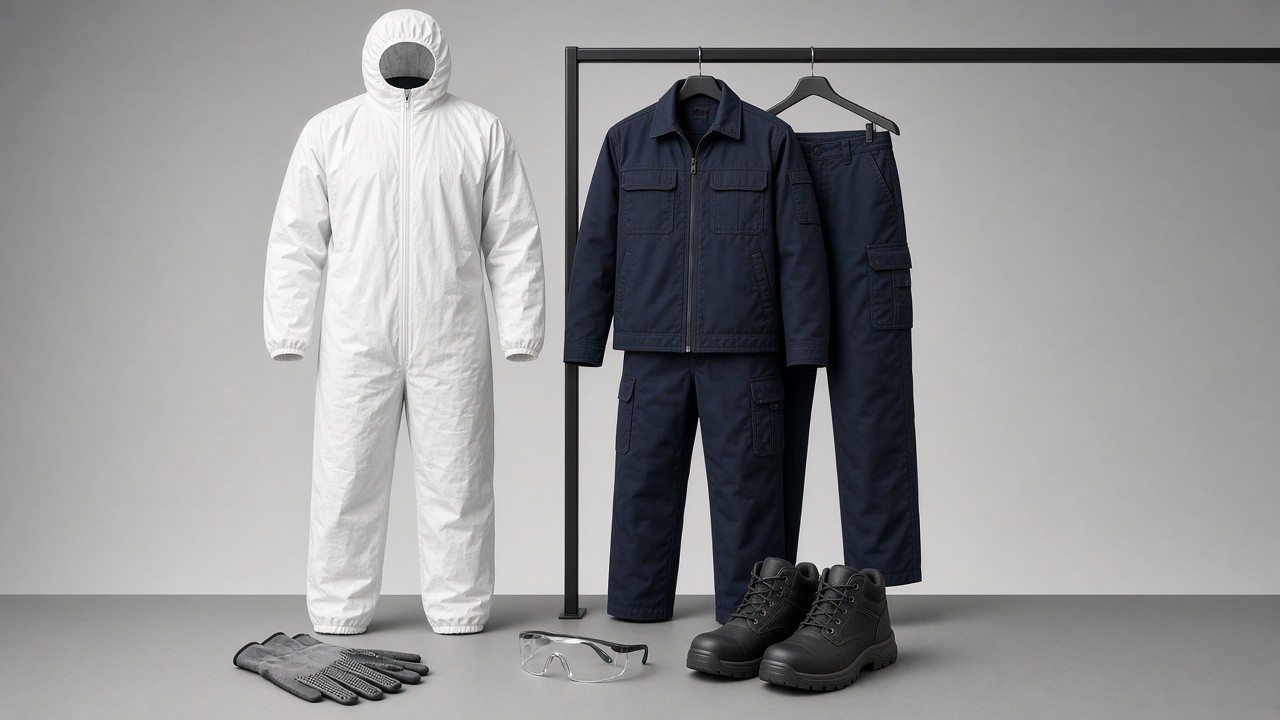
Protective Clothing for High-Standard Cleanroom Environments
When operators need to wear protective clothing through long shifts, the right choice must be easy to use, easy to train, practical to maintain, and reliable enough for continued production. CleanroomLink aligns garment specifications with your ISO cleanroom class, contamination control procedures, and process risks.
ISO 5–9
Cleanroom-ready selection range
RFQ-led
Specifications confirmed before order
Selection Snapshot
Start with the risk profile, not the garment name
Protective clothing should support a documented risk assessment covering contamination, fluid exposure, electrostatic discharge, operator movement, laundering, and expected wear time. Use the following starting points, then confirm the final model through samples and RFQ review.
High-control sterile areas
High-density, low-linting synthetic fabrics designed to minimize skin exposure and support superior particulate control in Grade A/B environments.
Long-shift production zones
Durable reusable or limited-use garments that balance operator comfort, movement, maintenance requirements, and baseline contamination control.
Specialized process risks
Materials with chemical splash resistance or ESD protection for precision manufacturing, chemical handling, and other controlled industrial zones.
Specification Table
Build a clearer RFQ before comparing offers
Each field affects unit pricing, lead times, testing, packaging, and compliance documentation. Items marked for confirmation should be finalized during the RFQ stage rather than assumed from a product category.
| Parameter | Specification Details |
|---|---|
| Product Category | Coveralls, lab coats, hoods, shoe covers |
| Core Performance | Particle filtration efficiency and fluid repellency; model-specific performance to be confirmed |
| Protection Level | ISO Class 5 to 9 / cleanroom-ready; final suitability depends on model and process validation |
| Material | Antistatic polyester, SMS, microporous film, or custom material |
| Applicable Risks | Particulate contamination, chemical splash, ESD |
| Applicable Industry | Pharma, semiconductor, food processing, MedTech |
| Size / Spec | S to 4XL / custom dimensions |
| Durability | Single-use disposable or reusable; laundry testing to be confirmed |
| Related Standards | EN, ASTM, ISO, GB; target-market requirements and certificates to be confirmed at RFQ |
| Typical Application | Sterile manufacturing, PCB assembly, cleanroom maintenance |
| Supporting PPE | Gloves, masks, goggles, and hairnets |
| Custom Options | Logo branding, specific stitching, custom pocket placement, and other design modifications |
Three Buying Scenarios
A procurement route for each operating constraint
01 / Compliance-first
For pharmaceutical and biotech teams
Prioritize garments with documented validation for relevant EN standards or ISO 13997:2024 where applicable. The documentation package should match your internal QA audit requirements.
02 / Cost optimization
For standard industrial cleanrooms
Compare high-performance alternatives against GB or ISO requirements to control total purchase cost without removing the protection needed for the process.
03 / Integrated system
For consolidated supply chains
Bundle protective clothing with wipers, gloves, and air shower supplies to reduce supplier administration and coordinate logistics.
Performance Explained
Barrier integrity is a system decision
The fabric, seam construction, closure design, donning method, and supporting PPE all interact with your process. A garment that works in one area may be unsuitable in another.
Particle shedding
Low-linting materials help reduce fiber release and support cleanroom air-quality controls.
Fluid and cross-contamination barriers
Fluid-resistant SMS may suit high-turnover areas, while high-density polyester can support controlled, clean-processed cycles.
Protective clothing versus adjacent PPE
Protective clothing controls body and garment-related contamination; it does not replace task-specific gloves, masks, goggles, hairnets, or respiratory protection.
Disposable coveralls can simplify high-turnover use, while reusable garments may reduce recurring waste and cost when validated laundering and inspection are available. The correct boundary depends on the risk assessment, cleanroom class, process chemicals, and maintenance system.
Compliance Notes
Documentation should match the delivered batch
Compliance is not a static label. We help verify that the selected protective clothing aligns with the regulatory requirements of your target market and the physical performance expected from the order.
- ✓CE-marked garments and relevant EN documentation for European export requirements, where applicable.
- ✓ASTM-related documentation for North American manufacturing requirements, where applicable.
- ✓Technical data sheets and third-party laboratory reports available on request for the specific model or batch.
- ✓Final standards, certificate scope, test method, and batch records to be confirmed during RFQ.
Custom Options
Adapt the garment to the way your team works
A protective clothing manufacturer or supplier should be able to discuss operational details, not just standard size charts.
Custom sizing
Adjustments for localized workforce ergonomics and custom dimensions.
Branding
Private labeling or embroidery for facility-specific identification.
Design changes
Specific closures, pocket placement, stitching, or accessory loops.
Packaging & Delivery
Protect the product before it reaches the controlled area
Cleanroom supplies must arrive in a condition that supports your contamination-control protocol. Packaging and logistics requirements should be included in the purchase specification.
Cleanroom-compatible packaging
Double-bagging and vacuum sealing where required; final packaging method is available on request.
Batch traceability
Coordinate technical documentation and batch records with each shipment.
Logistics coordination
Plan shipping to minimize transit risk and cost for wholesale and recurring supply programs.
Frequently Asked Questions
Questions to resolve before approval
How do I choose between polyester, SMS, and microporous film?
Selection depends on particle control, fluid or chemical exposure, ESD needs, comfort, intended use, and whether the garment is disposable or reusable. The final material should be confirmed against your process risk assessment and sample testing.
How do I verify filtration and barrier performance?
Request the technical data sheet and, where needed, third-party laboratory reports corresponding to the specific model or batch. Test methods and acceptance criteria should be stated in the RFQ.
Can I receive samples before a wholesale order?
Yes. Sample validation is recommended for fit, donning, operator comfort, contamination-control procedures, and performance in the actual production environment.
How should protective clothing be stored?
Follow the storage guidance supplied for the selected material, including any temperature, humidity, packaging-integrity, and light-control requirements. Conditions are model-specific and available on request.
How long will reusable garments last?
Service life depends on fabric, laundering process, inspection criteria, frequency of use, and contamination exposure. A precise lifespan should not be assumed without laundry validation and a replacement policy.
What is the difference between standard and premium lines?
Premium lines typically offer deeper international certification and are engineered for higher-frequency reuse or sterile processing. Standard lines focus on cost-effective, high-volume performance. Exact differences depend on the model and documentation package.
Send Your Specs
Discuss Your Application
Protective clothing is a risk-management decision, not a generic catalogue purchase. For complex conditions, discuss the process first so material, construction, standards, packaging, samples, and delivery can be aligned with your production goals.
Contact CleanroomLink
Email:
Address: