
Cleanroom Environmental Monitoring
Precision Temperature & Humidity Meters for Controlled Environments
Stable temperature and humidity measurements help protect product integrity, reduce excursion risk, and support compliance in cleanrooms and critical production areas. CleanroomLink helps overseas procurement teams, engineers, and quality managers match the right meter, transmitter, or data logger to the measurement task.
Spot-check
Portable validation and audits
24/7
Continuous monitoring options
RFQ-ready
Specification matching support
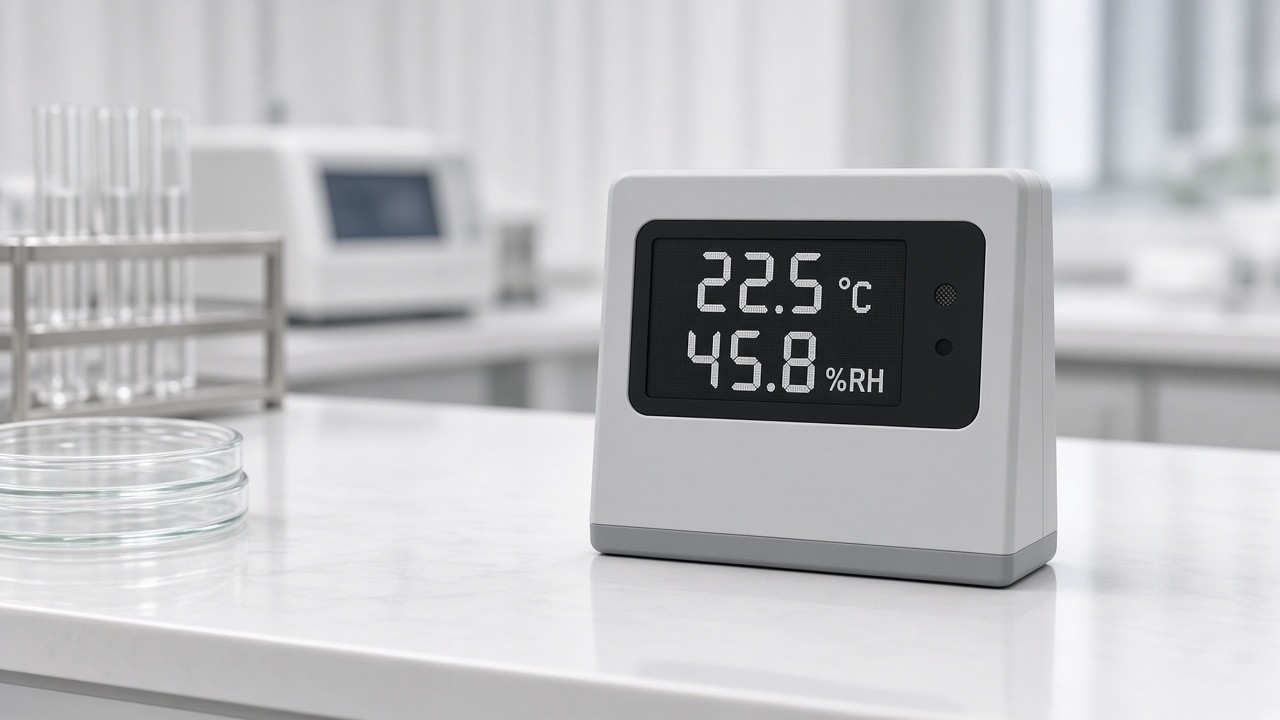
Measurement focus
Temperature, relative humidity, excursions, and historical records.
Procurement focus
Accuracy, calibration, interfaces, housing, and service life.
Material First
The sensing environment determines the meter specification
In a cleanroom or critical production facility, an environmental reading is only useful when the sensor remains stable, cleanable, and suitable for the surrounding process. Temperature drift can affect product behavior and storage conditions, while humidity excursions may increase microbial risk, corrosion, or electrostatic discharge.
Industrial Temperature & Humidity Meters commonly use high-stability capacitive polymer humidity sensors with thermistor or RTD temperature elements. The final sensor construction, housing, communication method, and calibration package should be selected around the contamination-control protocol and the required measurement evidence.
Material Choices & How to Select
Match the measurement method to the risk and workflow
A Temperature & Humidity Meters supplier should first confirm where measurements are taken, how often they are needed, and how the result will be used during validation, production, or an audit.
Portable handheld meters
Suitable for validation, audits, troubleshooting, air-shower entry points, worktables, and other locations requiring flexible spot-checks.
Prioritize: portability, probe access, display, and calibration evidence.
Wall-mounted transmitters
Designed for permanent monitoring and connection to a Building Management System or facility monitoring platform.
Prioritize: output protocol, alarm logic, installation, and continuous sampling.
Data loggers
Useful for mapping studies, transport checks, long-term storage verification, and demonstrating historical conditions during inspections.
Prioritize: memory, interval settings, export method, and battery life.
Material and housing choices
For controlled environments, request smooth, low-particle, crevice-reduced housing materials that tolerate the expected cleaning and decontamination cycle. Chemical resistance to VHP or other agents is model-dependent and should be confirmed before purchase.
When a standard HVAC sensor is not enough
Choose a cleanroom-oriented model when calibration traceability, faster excursion capture, historical records, or integration through RS485, Modbus, Ethernet, 4–20 mA, or another defined interface is required. Compatibility remains subject to model and system review.
Parameter Table
Confirm the specification before quotation
The values below are matching fields, not a universal datasheet. Final figures, certificates, and interface details must be confirmed during the RFQ stage.
| Specification | Typical requirement / RFQ confirmation |
|---|---|
| Measurement items | Temperature and relative humidity; additional parameters depend on model |
| Measurement range | To be confirmed per application and model |
| Accuracy | Temperature: ±0.2°C to ±0.5°C; humidity: ±2% RH to ±3% RH, depending on model |
| Resolution | 0.1°C / 0.1% RH, subject to model confirmation |
| Sampling flow / method | Continuous or interval-based; active flow requirements are To Be Confirmed |
| Response time | Less than 15 seconds typical; confirm test conditions and model |
| Display | LCD, LED, or digital readout; depends on model |
| Data storage | On-board memory, cloud-based, or no internal storage; confirm retention requirement |
| Communication interface | Modbus RTU, RS485, 4–20 mA, Ethernet, or other interface; system compatibility to be confirmed |
| Alarm | Programmable high/low thresholds; local and remote alarm options depend on model |
| Calibration requirement | Routine recalibration required; ISO/IEC 17025 accredited certificate Available on Request |
| Power supply | Battery, 24V DC, PoE, or other option; depends on model |
| Applicable standards | ISO 14644, GMP, ASTM E2500, and local requirements; applicability to be confirmed |
Construction Details
Cleanable construction supports reliable readings
The physical design should protect the sensing element without creating particle traps or limiting access during sanitization. A specification review should cover the housing, probe, cable entry, mounting method, and expected chemical exposure.
Smooth surfaces
Crevice-reduced forms help simplify cleaning and reduce particle entrapment.
Sensor stability
Capacitive polymer humidity elements and thermistor or RTD temperature elements are selected by model.
Decontamination fit
VHP and chemical resistance are available for selected constructions and require confirmation.
Integration-ready
Digital and analogue outputs can support facility monitoring when protocol and wiring requirements match.
Performance Consequences
The wrong meter can create a false pass
A reading that looks acceptable is not enough if the instrument is slow, poorly calibrated, unsuitable for the cleaning cycle, or unable to preserve the evidence required by your quality system.
Compliance exposure
Inaccurate or incomplete records can weaken an audit response, validation package, or certification position.
Yield and product risk
Low humidity may increase ESD risk in electronics, while high humidity can contribute to corrosion or process instability.
Missed excursions
Slow response or insufficient data storage may hide short temperature spikes and compromise historical analysis.
Applications
Built around the measurement task
Pharmaceutical cleanrooms
Support controlled conditions, mapping, batch review, and GMP-oriented monitoring workflows.
Electronics production
Help identify humidity conditions associated with ESD, corrosion, and sensitive assembly processes.
Food and controlled storage
Track storage and processing environments where temperature excursions may affect quality or shelf life.
Facility validation
Use portable meters and data loggers for audits, air-change studies, commissioning, and verification.
A practical integration approach
CleanroomLink can help define monitoring points, review air-change rates and heat loads, align the instrument package with FDA, EMA, NMPA, ISO 14644, or GMP requirements, and consolidate procurement with cleanroom consumables and PPE.
Frequently Asked Questions
Questions procurement and quality teams ask
What materials and housing should I request for a cleanroom? +
Request smooth, non-shedding, chemically resistant construction appropriate for your cleaning and decontamination cycle. VHP compatibility is model-specific and should be included in the RFQ rather than assumed.
Do the meters include calibration certificates? +
Calibration documentation should be requested with the quotation. Certificates traceable to national or international standards, including ISO/IEC 17025 accredited options, are Available on Request depending on model and service scope.
How often should the sensors be recalibrated? +
Annual recalibration is a common starting point, while high-criticality areas may require semi-annual checks. The interval should reflect risk, drift history, use conditions, and your quality procedure.
How do I balance accuracy, response time, storage, and service life? +
Define the consequence of an excursion first. Faster response and tighter accuracy may affect cost, calibration workload, or battery life. Long-term logging requires sufficient memory and a clear export process. A sample validation using your actual environment is recommended before volume purchase.
Can these meters connect to an existing BMS? +
Many wall-mounted transmitters support industrial interfaces such as Modbus or RS485, while some configurations use 4–20 mA or Ethernet. Share the BMS protocol, wiring, power, and alarm requirements for compatibility review.
Request Material Recommendation
Send Your Current Spec
Already using a specific brand or model? Send your current datasheet, target range, accuracy, calibration requirement, storage interval, and communication interface. CleanroomLink will perform a technical cross-reference for an equivalent, cost-optimized, or more supply-stable solution.
We can also review your cleanroom class, cleaning agents, VHP exposure, BMS protocol, applicable standards, and sample validation plan before quotation.
Share your requirements
Include the existing model, target specifications, quantity, destination, and any required certificates.