
Evidence-Led EPA Verification
ESD Testers and Verification Systems for EPA Compliance
For overseas purchasing teams, quality engineers, compliance specialists, and factory managers, CleanroomLink provides ESD testers and monitoring equipment to validate Electrostatic Protected Areas with repeatable, auditable data.
As a solution integrator and ESD testers supplier, we help manufacturing facilities, cleanrooms, and electronics assembly lines select, calibrate, and deploy the right instruments for ANSI/ESD S20.20 and IEC 61340 programs.
EPA
System-level verification
3 vectors
Material, ground, and monitor
RFQ-ready
Model and audit matching
Use case
New EPA setup or routine audit
Output
Quantitative, defensible results
Test / Inspection Focus
Start with the acceptance criteria, not the catalog.
Reliable ESD control depends on consistent measurement. Before recommending a model, we connect the test method to the area being accepted, the required resistance range, and the audit evidence your team must retain.
Material characterization
Verify flooring, work surfaces, and garments remain within the dissipative range rather than becoming conductive or insulative.
System grounding
Test the path-to-ground for personnel, equipment, and workstations against defined operational limits.
Continuous monitoring
Detect ground failures at the workstation before they remain unnoticed during a production shift.
Technical Specifications
Parameter table for model and RFQ alignment
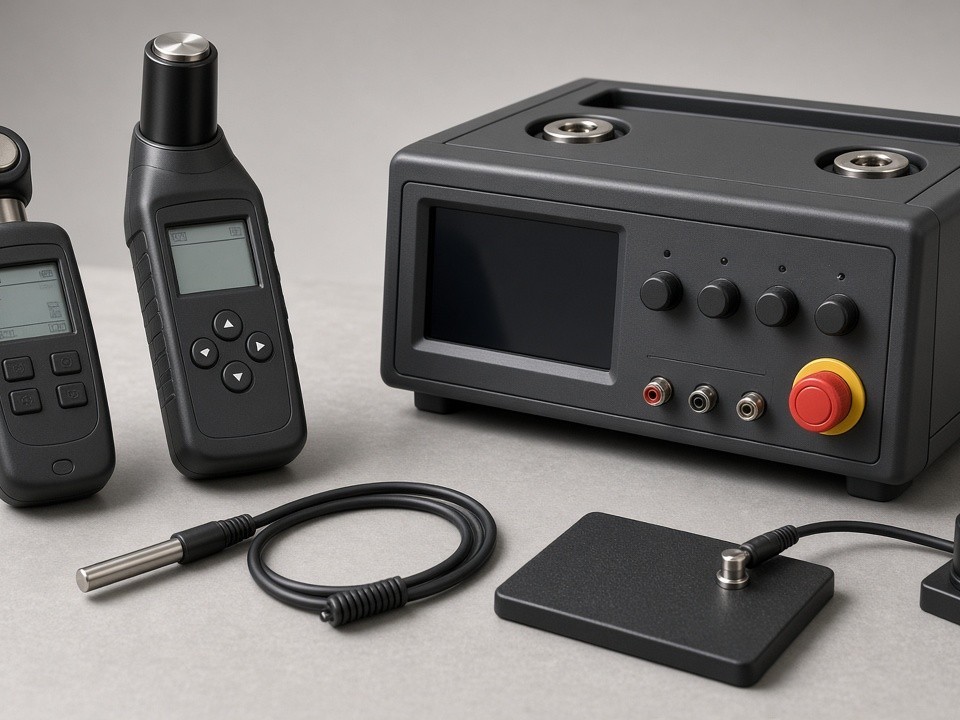
The standard range includes surface resistance meters, wrist strap and footwear testers, and continuous monitors. Actual values, tolerances, and calibration intervals vary by model and must be confirmed during the RFQ process.
| Specification | Typical capability / range | RFQ confirmation |
|---|---|---|
| Material / housing | ABS, conductive plastic, or industrial steel | Depends on model |
| Surface resistance range | 10³ to 10¹² Ohms | Variable by model |
| Volume resistance range | 10³ to 10¹¹ Ohms | Depends on model |
| Static decay time | < 2 seconds, 5000V to 50V | Confirm test condition |
| Grounding method | Banana jack, ring terminal, or auto-grounding | Depends on model |
| Dimensions | Handheld to benchtop formats | Custom / to be confirmed |
| Color | Standard ESD yellow or grey | Customizable for OEM |
| Load / wear parameters | Rated for continuous industrial use | Confirm duty cycle and environment |
| Test method | ANSI/ESD S4.1, S7.1, and STM 2.1 | Match to audit method |
| EPA applicability | Suitable for Class 0 to Class 3 sensitive environments | Confirm application boundary |
| Expected lifespan | 2–5 years | Calibration dependent |
| Applicable standards | CE, ISO, ANSI/ESD S20.20, IEC 61340 | Certificate availability by model |
Precise tolerance, calibration interval, certificate scope, and production configuration are available on request and must be confirmed before order approval.
What Results Mean
Turn readings into an acceptance decision.
An ESD tester is valuable when its output can be interpreted against your internal QA rules and target standard. Our technical team helps map the instrument range to the inspection record your facility needs.
Resistance ranges
Values below 10³ Ohms may indicate a short or excessive conductivity, while values above 10¹² Ohms may indicate an insulative material that cannot dissipate charge.
Decay time
Slow decay can point to an ineffective grounding path or unsuitable material selection. Confirm the voltage range and test setup before comparing results.
Pass / fail thresholds
Tolerance bands can be aligned with your internal QA requirements, whether the program follows military-grade controls or commercial electronics protocols.
Application Fit
Choose the instrument by its role in the EPA.
ESD testers are not interchangeable. The right selection depends on whether you are qualifying materials, controlling entry, or protecting an active workstation during production.
Surface resistance meters
For periodic verification of mats, floors, tables, and other materials during initial setup and routine audits.
Wrist strap and footwear testers
Placed at EPA entry points to check personnel grounding before operators enter the production floor.
Continuous monitors
Installed at workstations to provide immediate feedback when a wrist strap or work-surface ground fails.
Selection boundary
For high-volume assembly lines, periodic checks can leave a blind spot between manual inspections. Integrated continuous monitoring is usually the more appropriate upgrade path.
Documentation
Build an audit file that supports the equipment decision.
We help purchasers and quality teams connect product specifications with regulatory expectations. Documentation scope depends on the selected model, destination market, and RFQ requirements.
Calibration records
Traceability and calibration documentation available according to the selected configuration.
Shipment test reports
Performance records can be requested for the unit or batch supplied.
Compliance guidance
Map specifications to CE, ISO, ANSI/ESD, IEC, ISO, or GMP audit needs.
Frequently Asked Questions
Practical answers for replacement and sourcing decisions.
Can these ESD testers replace our current brand?
Yes. Share the existing make, model, resistance range, test method, and required output. We can benchmark an equivalent or improved alternative against the current specification.
Can you match an existing specification?
We can compare the existing instrument with standard and upgraded options. Final equivalence depends on accuracy, calibration scope, grounding method, environmental conditions, and target standards.
What causes the price difference between standard and premium models?
Differences commonly reflect sensitivity, accuracy, calibration certification level, monitoring capability, and deployment scale. We can prepare a cost-focused and high-precision comparison.
What is the validation process?
Provide your target standard, application, current tester data, audit method, and quantity. We then confirm the parameter set, recommend a model, review available documentation, and align shipment testing with your acceptance plan.
Are custom OEM ESD testers available?
Custom branding, dimensions, colors, and compliance ranges may be available. Lead time depends on complexity and order quantity, so include your timeline in the RFQ.
Are calibration certificates included?
Calibration documentation is available according to the selected model and order scope. Certificate traceability, interval, and applicable standard should be confirmed before purchase.
Compare Options
Ask for test data and a two-option proposal.
Tell us your budget, target standard, and EPA application. We will return a Standard Compliance Solution for cost-sensitive deployment and an Advanced Verification Solution for high-precision or continuous monitoring requirements.
- ✓Target standard: ANSI/ESD S20.20, IEC 61340, or another requirement
- ✓Application: semiconductor, medical device packaging, electronics, or cleanroom production
- ✓Scope: single calibration unit, replacement purchase, or bulk facility deployment
- ✓Existing make, model, resistance range, and required documentation if available
Request an ESD tester comparison
Share your project details with our sourcing and quality team.
Email:
Phone: