
Precision Grounding Testers for Cleanroom ESD Compliance
In semiconductor assembly, pharmaceutical packaging, and other high-stakes manufacturing environments, static discharge can threaten product yield and audit readiness. CleanroomLink provides calibrated grounding measurement solutions that connect production requirements with disciplined ESD verification.
Specification map
Choose around the measurement task
Performance
- Resistance range and accuracy
- Test voltage and resolution
- Response time and alarm thresholds
Dimensions
- Bench, portable, or integrated format
- Probe and cable configuration
- Dimensions: depends on model
Compliance
- ANSI/ESD S6.1 alignment
- IEC 61340-5-1 requirements
- Calibration documentation for review
Use environment
- Cleanroom and production-floor use
- EMI and airflow considerations
- Battery or AC operation options
Product role in the system
The verification gate for your ESD program
A grounding tester does more than measure resistance. It validates that workbenches, floor mats, equipment chassis, and other controlled assets are effectively connected to the facility’s common ground point.
Preventive verification
Build routine checks into maintenance schedules before grounding failures become production incidents or audit findings.
Traceable decisions
Use consistent measurement methods, calibration records, and stored results to support quality and compliance teams.
Built around real measurement tasks
Select the tester according to the assets being checked, the resistance range required, the applicable standard, and the way your operators need to record results.
Upstream / downstream interfaces
Where grounding testers connect to your operation
The tester sits between facility engineering controls and day-to-day production verification.
Upstream
Facility grounding
- •Ground busbars
- •Electrical distribution panels
- •Common ground points and industrial lugs
Measurement point
Grounding tester
Interface cables, probes, test voltage, thresholds, and data outputs are matched to the specified ESD test protocol.
Downstream
Controlled assets
- •ESD-safe work surfaces and floor mats
- •Personnel grounding wrist straps and footwear testers
- •Conductive flooring and equipment chassis
CleanroomLink can review your existing cables, probes, grounding lugs, and test procedures to help align the selected unit with international ESD verification practices.
Application risk analysis
Avoid false passes before you lock the specification
A low-cost or general-purpose instrument may produce a reading without proving that the measurement is valid for your ESD control plan. Selection should begin with the risk, asset, and standard.
Precision versus range
A broad facility-grounding range may not provide the sensitivity needed for sensitive electronic component or cleanroom surface testing.
Environmental interference
High airflow, ionization systems, and nearby electrical equipment can affect readings. EMI protection and a repeatable test method may need to be confirmed.
Instrument boundary
Unlike a standard multimeter, a specialized tester applies defined test voltages, such as 10V or 100V where required by the selected protocol.
Selection boundary
Grounding tester or general multimeter?
A standard multimeter is designed for general electrical troubleshooting. It should not automatically be treated as proof of ESD compliance because it may not provide the required test voltage, resistance range, thresholds, repeatability, or records.
Procurement checkpoint
Confirm the target asset, resistance limits, test voltage, calibration evidence, and applicable standard in the RFQ.
Technical specification matrix
Parameters to confirm during RFQ
Values vary by model and application. The final specification should be locked against your audit requirements, test method, and controlled assets.
| Parameter | Specification / RFQ status |
|---|---|
| Measurement item | Grounding resistance and ESD grounding continuity; confirm asset type during RFQ |
| Measuring range | Depends on model; example range may be 10³ to 10¹² ohms |
| Accuracy | Depends on model; factory-calibrated accuracy may range from ±5% to ±10% |
| Resolution | Depends on model; 0.1 decade or 0.01 MΩ options may be available |
| Sampling method | Probe-based resistance measurement; sampling flow and method to be confirmed |
| Response time | Depends on model; under 2 seconds may be available |
| Display | Digital LCD or LED indicator, depending on model |
| Data storage | Internal memory or USB export available on selected models |
| Communication interface | RS232, USB, or wireless options; confirm integration requirement |
| Alarm | Visual and audible alarm with adjustable thresholds, depending on model |
| Calibration requirement | Factory calibration; ISO/IEC 17025 traceability documentation available on request |
| Power | Battery-operated or AC adapter configuration |
| Applicable standards | ANSI/ESD S6.1, IEC 61340-5-1, and GB/T 30077 alignment to be confirmed by model and project |
Any value marked as model-dependent, available on request, or to be confirmed should be included in the RFQ for formal validation before purchase.
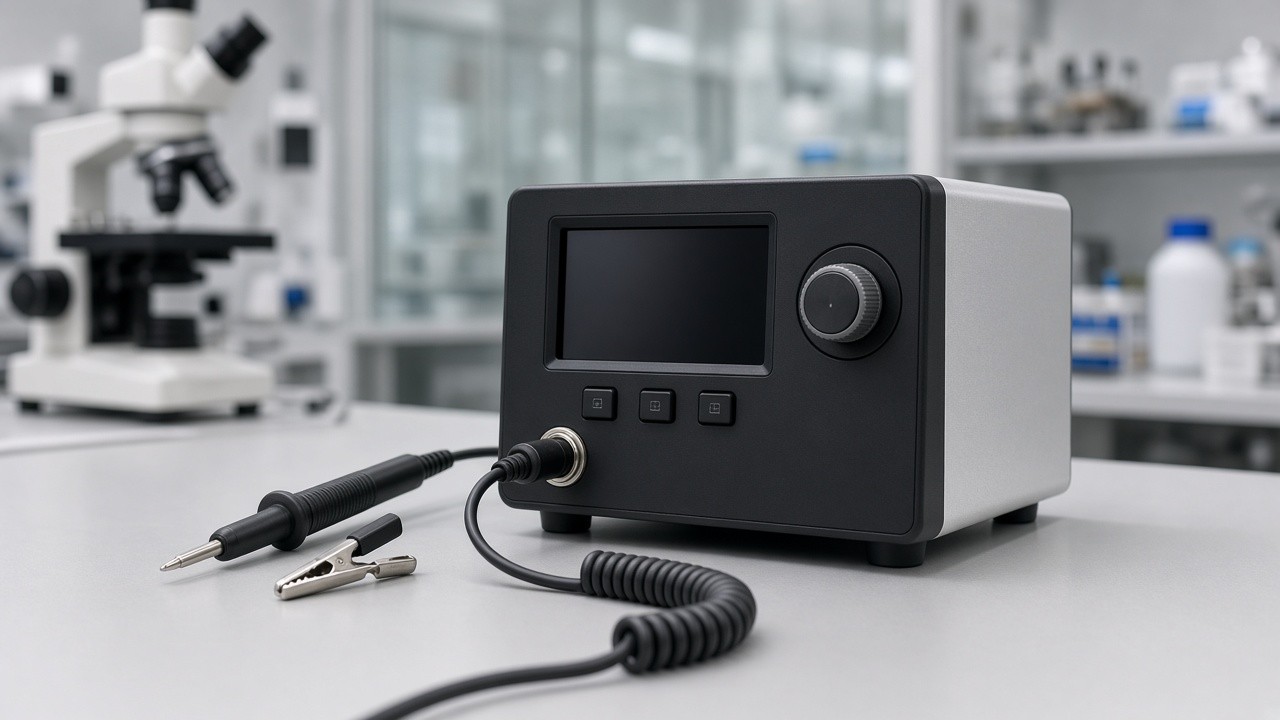
Integration considerations
Move from a product purchase to a verified measurement system
- 1
Map the standard
Identify whether your target market, auditor, or internal procedure requires ANSI/ESD, IEC, ASTM, EN, or another framework.
- 2
Confirm calibration readiness
Specify certificate format, traceability expectations, recalibration interval, and records needed by QA or third-party auditors.
- 3
Consolidate related sourcing
Where required, combine testers with conductive mats, grounding cords, probes, and verification kits through one coordinated supplier.
Application examples
Match the tester to the controlled environment
01 / Electronics
Semiconductor assembly
Verify workstations, mats, chassis, and common grounding points where a false pass could affect sensitive components and yield.
02 / Pharmaceutical
Packaging operations
Support documented maintenance checks in controlled packaging areas where grounding records form part of quality evidence.
03 / Cleanroom
ESD-controlled facilities
Account for airflow, ionization, EMI, operator procedures, and repeatable probe placement when selecting a measurement method.
Inspection and acceptance
Verify performance before the unit enters service
A defined acceptance process helps procurement, engineering, and QA confirm that the delivered tester matches the approved specification.
Delivery review
Check model, accessories, cables, probes, power configuration, manuals, and requested calibration documentation.
Performance check
Confirm the approved test voltage, resistance range, response behavior, display, alarm thresholds, and data output.
Commissioning support
If on-site verification does not meet the agreed specification, the issue can be routed for calibration adjustment or replacement review.
Replacement cycle
Protect measurement integrity over time
A biennial calibration cycle is recommended in the supplied program guidance, but the final interval should follow your risk assessment, usage frequency, internal procedure, and auditor requirements.
Monitor
Calibration status and usage history
Review
Drift, damage, failed checks, and changing standards
Replace
When repair, range, or compliance needs exceed the current model
Frequently asked questions
Answers for project-based procurement
Can the specification be locked before a purchase order?
Yes. Share the measurement item, range, accuracy, test voltage, data requirements, calibration documentation, environment, and applicable standards. Model-dependent fields should be confirmed in the RFQ and technical datasheet.
Can we approve a sample before placing a bulk order?
Sample evaluation can be planned around your existing ESD flooring, mats, grounding lugs, SOP, and acceptance checklist. Confirm sample quantity and approval criteria during project review.
What is the lead time for wholesale or bulk orders?
Standard units are typically quoted at 2–3 weeks in the supplied program guidance. Custom-integrated systems may require additional assembly and verification time; the confirmed schedule depends on model and order quantity.
How do you support continuous supply?
A supply plan can define the approved model, replacement policy, calibration records, accessory configuration, batch documentation, and forecast quantities for repeat orders.
Can I request a calibration certificate for an audit?
Calibration documentation with ISO/IEC 17025 traceability is available on request, subject to model and certificate scope. Specify your auditor’s requirements at the start of the project.
Do you provide operator training?
Technical datasheets, remote video training, and SOP guidance can be discussed for maintenance and production teams.
Project inquiry
Ask for Technical Datasheet & Pricing
Send your grounding tester requirements to receive a technical review and a comparative quote suited to your measurement task, certification expectations, and supply plan.
- ✓Grounding tester specifications and application matching
- ✓Calibration and standards documentation review
- ✓Sample approval, bulk delivery, and continuous supply planning
Tell us about your project
Include the target assets, resistance range, test voltage, standards, quantity, destination, and required delivery date.