
Static Pass Boxes for Controlled Material Flow
Static Pass Boxes: Secure Material Transfer for Controlled Environments
CleanroomLink helps overseas procurement teams, engineers, quality specialists, and factory managers specify passive transfer equipment that supports zone separation, door interlocking, and clean material movement.
Three questions buyers ask first
-
1
Does the process require active air filtration, or is a passive, sealed transfer sufficient for the contamination-control strategy?
-
2
Will high-frequency material flow require electronic interlocks, or is a mechanical system adequate?
-
3
Which ISO, GMP, FDA, or local GB requirements define the surface finish and material grade for the cleanroom?
Quick Buyer Fit
Is a static pass box right for your transfer route?
A static pass box is generally appropriate when the room pressure differential and operating procedure provide the required contamination control without dedicated recirculating airflow or HEPA filtration.
Good fit when
- ✓Material must cross a wall or boundary without opening the cleanroom door.
- ✓Existing room pressure relationships are part of the contamination-control plan.
- ✓Low operating cost and simple maintenance are procurement priorities.
Review a dynamic model when
- !Active HEPA-filtered airflow is required during transfer.
- !The process needs controlled purge cycles or independent air handling.
- !Site validation requires airflow data unavailable from a passive unit.
Where It Works
A controlled handoff between zones
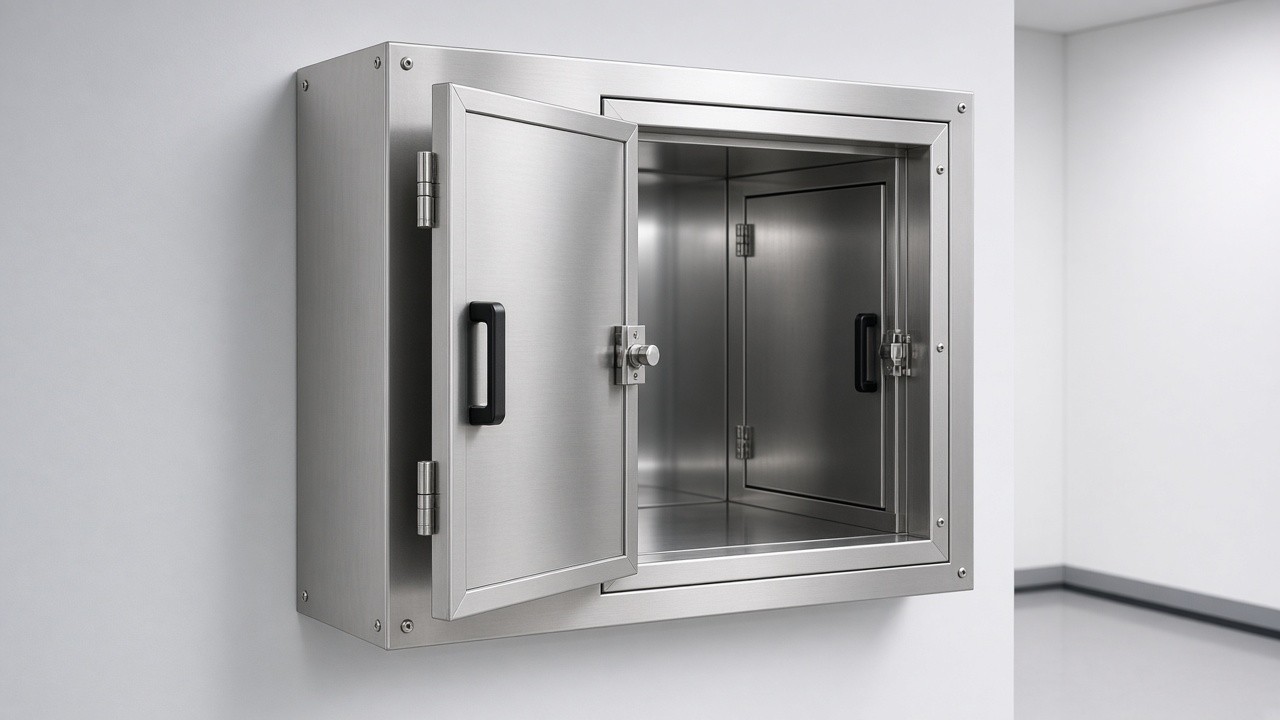
Static pass boxes act as airlocks between cleanroom zones with different cleanliness levels or between a controlled room and an uncontrolled area. Their purpose is to protect the material flow path, reduce unnecessary personnel movement, and preserve the room boundary.
Pharmaceutical packaging
Move components toward sterile filling and packaging areas.
Electronics assembly
Transfer wafers and sensitive parts while limiting human traffic.
Laboratories
Move samples into and out of controlled testing zones.
Food processing
Pass materials through walls without breaching the clean air seal.
How to Select
Specify the transfer route before the cabinet
A reliable Static Pass Boxes supplier should begin with your wall construction, material dimensions, cleanroom classification, door-control logic, and operating procedure—not with a generic stainless steel cabinet.
Interlock mechanism
Mechanical systems are simple and require no power. Electromagnetic or time-delay systems can provide indicators, emergency release, and monitoring interfaces.
Mounting condition
Confirm wall thickness, opening dimensions, service access, and whether the unit is wall-embedded, wall-mounted, or floor-mounted.
Finish and cleanability
SUS304 may suit standard cleanrooms; SUS316L, electropolishing, and specific surface finishes may be required for higher-grade pharmaceutical environments.
Disinfection strategy
If your SOP requires surface sterilization, specify an optional interlocked UV lamp or another approved cleaning method at RFQ stage.
Final Specification Confirmation
Technical specification overview
The following fields should be confirmed against site drawings, process requirements, and validation documents before purchase. Values not defined in the project brief remain model-dependent or require RFQ confirmation.
| Parameter | Specification / RFQ status |
|---|---|
| Type | Static, non-airflow transfer box |
| External dimensions | Custom; depends on model and site opening |
| Internal dimensions | Custom; confirm product envelope and clearance at RFQ |
| Cabinet material | SUS304 / SUS316L stainless steel; grade to be confirmed |
| Door interlock | Mechanical / electromagnetic / time-delay; confirm monitoring and emergency release needs |
| Filtration system | None for standard static configuration; active filtration requires a dynamic model review |
| Air velocity | Not applicable to standard non-airflow configuration; to be confirmed if airflow is specified |
| Pressure differential | Relies on existing room pressure strategy; site value to be confirmed |
| Disinfection option | Optional UV lamp, interlocked; availability on request |
| Sealing method | High-density EPDM or silicone gasket; confirm compatibility with cleaning agents |
| Power supply | Depends on interlock and UV options; 220V/50Hz stated in the project brief, to be confirmed |
| Cleanliness level | ISO 5 to ISO 8 / Class 100 to 100,000 stated range; final classification to be confirmed |
| Installation method | Wall-mounted, wall-embedded, or floor-mounted; confirm wall thickness and fixing details |
Material & Construction
Built around cleanability and sealed transfer
Construction should minimize dust traps and support repeatable cleaning. Interior corners are typically arc-welded or designed with large radii, while food-grade or pharma-grade stainless steel can be specified according to the process.
Confirm compatibility with cleaning agents such as IPA or hydrogen peroxide vapor during the RFQ process. Gasket material, surface finish, and weld quality should be evaluated together rather than selected independently.
Standards & Documentation
Prepare the validation file early
- ISO 14644: Consider how the pass box supports the classification of the surrounding cleanroom.
- GMP and FDA expectations: Review material, finish, cleanability, and documentation suitability for aseptic processing.
- Electrical safety: Confirm CE or applicable local requirements for interlock and control systems.
- Project records: Test reports and material certificates such as MTRs are available according to the confirmed supply scope.
Common Buying Mistakes
Avoid paying for the wrong transfer concept
Over-specifying active filtration
Do not purchase a more expensive dynamic pass box with HEPA filtration when a passive unit is sufficient for the room classification and transfer procedure.
Ignoring wall thickness
Missing the exact wall build-up or opening dimensions can cause installation delays and costly field modifications.
Assuming UV is standard
UV sterilization must be specified and interlocked when required by the SOP; it should not be assumed from a generic product description.
FAQ
Static pass box questions buyers need answered
When should I choose a static pass box over a dynamic pass box?
Choose a static model when material transfer does not introduce significant particulate matter and the room pressure differential is sufficient to limit backflow when doors are opened. A dynamic model is more appropriate when active HEPA-filtered airflow or purge control is required. Submit your room pressures, ISO class, and SOP requirements for a project-specific recommendation.
How is a static pass box different from a transfer hatch?
The terms may overlap in some markets, but the purchase decision should focus on the actual requirements: two-door interlocking, sealed construction, cleanable surfaces, mounting method, and the required documentation. Confirm the intended cleanroom boundary and operating sequence before comparing quotations.
Can the interlock connect to an existing BMS?
Yes, configurations with dry-contact outputs for interlock status monitoring can be provided. Confirm the BMS interface, alarm logic, emergency release, and electrical standard during RFQ.
What is the lead time for custom dimensions?
Custom fabrication typically requires 3–5 weeks depending on material availability and production volume. Final timing is available after dimensions, finish, interlock, documentation, and quantity are confirmed.
RFQ Checklist
Request Batch Pricing
For distributors, contractors, factories, and long-term procurement programs, CleanroomLink supports sourcing, quality verification, documentation, and logistics planning for static pass boxes.
Share the information below to receive a technical proposal and batch pricing. A floor plan or required dimensions will help us confirm the transfer route and installation approach.
Please include
- • Quantity, destination, and target delivery schedule
- • External and internal dimensions or product envelope
- • Wall thickness, mounting method, and site drawings
- • ISO class, pressure strategy, and cleaning SOP
- • Material grade, finish, gasket, interlock, UV, and BMS requirements
- • Required standards, test reports, certificates, and validation documents
Send your project requirements
Our technical team will review the application and confirm which specifications need to be finalized before quotation.