
Cleanroom surface decontamination
Industrial Sticky Rollers for Controlled Environments
Professional-grade sticky rollers for removing particles and lint from sensitive surfaces in electronics, pharmaceutical, medical device, and precision manufacturing environments.
ISO 5–8
Target cleanroom environments
Low residue
Adhesive options for sensitive surfaces
24 hours
Quotation target when RFQ data is complete
Built around your process
Select tack, film, core, dimensions, packaging, and documentation according to the surface and cleanroom protocol.
Procurement Brief
How to shorten your RFQ process
A complete specification lets our team identify the right Sticky Rollers supplier or manufacturer option faster and target an accurate quotation within 24 hours.
-
01
Application surface
State whether the surface is PCB, stainless steel, glass, plastic, or another substrate.
-
02
Cleanroom class
Provide the required ISO classification, such as ISO Class 5, 6, or 7.
-
03
Adhesion level
Indicate low, medium, or high tack, especially when cleaning delicate or coated surfaces.
-
04
Volume and documents
Share annual or batch volume and required RoHS, ESD, CoC, or other audit documentation.
Key Variables
Choose the construction around the surface
Sticky rollers are not interchangeable. Adhesive chemistry, film strength, core construction, and perforation affect both cleaning performance and contamination control.
Adhesive chemistry
Acrylic-based options are designed for low residue transfer, with tack calibrated to lift particles without leaving an adhesive film.
Film material
PE film is standard and provides tensile strength to help prevent tearing during use and sheet removal.
Core construction
Plastic cores support higher-cleanliness handling; paper cores are available for general industrial applications.
Perforation
Precision-cut perforations help each sheet peel cleanly without tearing the layers underneath.
Parameter Table
Final specification check before ordering
Use these fields to compare models, validate applications, and identify the information that must be confirmed during the RFQ stage.
| Parameter | Specification note | RFQ status |
|---|---|---|
| Material | PE film with acrylic adhesive | Model dependent |
| Basis weight / thickness | 30–50 μm film thickness | Depends on model |
| Dimensions | 4", 6", 8", 10", and 12"; custom widths available | Confirm width and roll length |
| Particle release | Low / controlled | Data available on request |
| Fiber release | Minimal / non-shedding target | Confirm by model |
| Absorbency | Not the primary function; confirm if liquid pickup is required | To be confirmed |
| Adhesion / tack | Low, medium, or high; customizable | Select during RFQ |
| Ionic residue | Batch and specification dependent | To be confirmed; report on request |
| Solvent compatibility | Compatible with standard IPA / DI water wiping applications | Validate against process chemicals |
| Sterility | Not stated as standard | To be confirmed if required |
| Pre-wetted status | Dry roller format is standard | Custom / available on request |
| Cleanroom class | Suitable for ISO Class 5 to 8 applications | Confirm facility protocol |
| Packaging | Sealed anti-static polybags, individual or bulk | Confirm cleanliness and pack quantity |
Standard solution
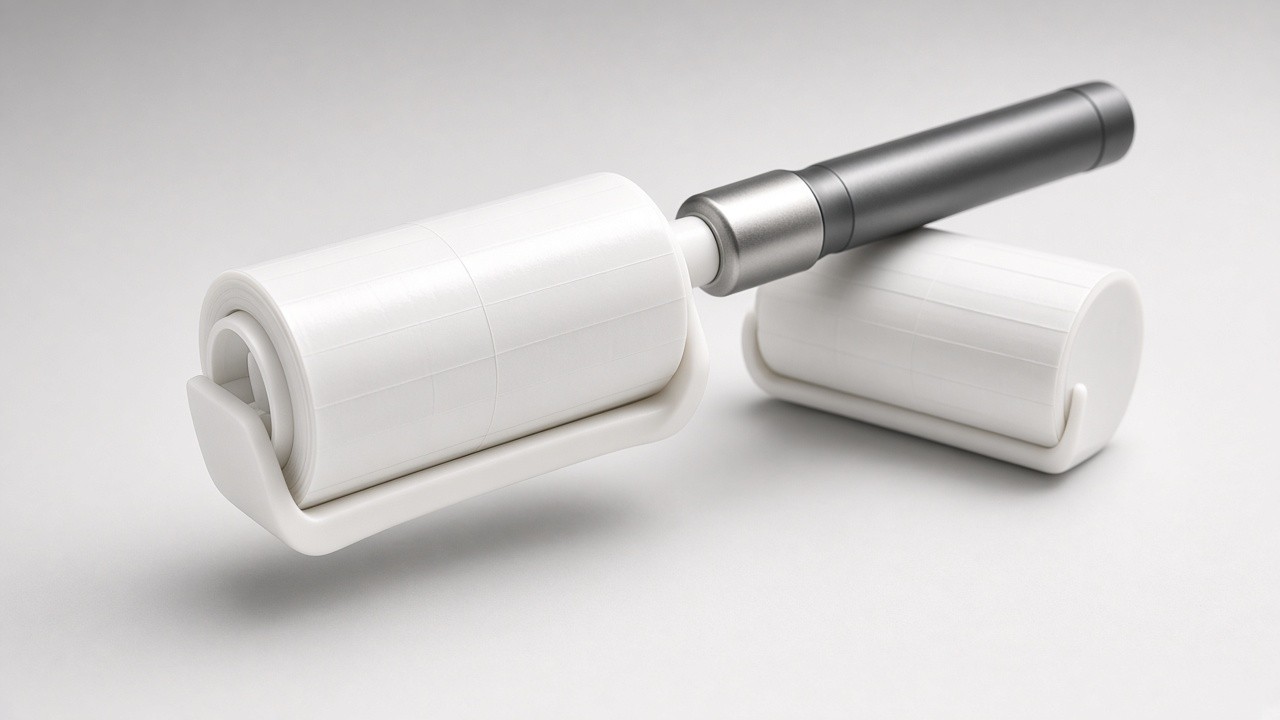
Handheld Sticky Rollers
An ergonomic handle and rotating roller head support manual spot-cleaning on workbenches, equipment covers, and final product inspection areas.
- ✓Fast deployment for line-side cleaning
- ✓Suitable for common standard widths
- ✓Practical for changing workstations
Custom integration
Machine-Mount Rollers
Automated lines require specific core diameters, lengths, and tolerances to prevent vibration or mounting misalignment. Provide a technical drawing or machine specification for review.
- ✓Core and length matched to the mounting bracket
- ✓Custom dimensions and tolerances available
- ✓Engineering confirmation required before production
Sticky Rollers vs. sticky mats
Sticky mats control floor-level contamination at room entrances. Sticky rollers are designed for direct-contact cleaning of components, equipment, and work surfaces, providing more precise particle removal where a mat cannot reach.
Use Cases
Applications across controlled manufacturing
Electronics and semiconductor
Remove dust and lint from PCBs and display glass before coating or assembly.
Pharmaceuticals
Clean stainless steel surfaces, cleanroom walls, and equipment before batch processing.
Medical devices
Support final surface inspection and particulate control on device manufacturing lines.
Precision manufacturing
Clean optical components and plastic housings in controlled environments.
Inspection Points
Checks for receiving and QA teams
Use a consistent incoming inspection routine to protect cleanroom performance and verify that the supplied model matches the approved specification.
Adhesion consistency
Check that tack remains uniform from the first sheet to the last.
Residue testing
Perform a tape test on a representative surface to verify that no adhesive transfers after contact.
Packaging integrity
Confirm that the outer bag is intact on arrival and has protected the product during transit.
Core fit
Verify fit with the existing handle or machine mount without excessive play or friction.
Commercial Considerations
Plan documentation, consistency, and landed cost
Certification
Applicable test reports can be sourced. Specify ISO, ASTM, RoHS, ESD, particle, or ionic-residue documentation for your audit.
Batch consistency
Lot-traceable products are available. State your supply-chain traceability requirements before ordering.
MOQ and wholesale pricing
Minimum quantities vary by customization. Tiered pricing is available for bulk and recurring volume.
Export logistics
International shipping coordination and export documentation support are available for overseas buyers.
FAQ
Answers for quality, compliance, and sourcing teams
Can you provide a Certificate of Conformance?
Yes. Every shipment includes a CoC. Specific third-party reports for particle counts or ionic residue are available on request for qualified orders.
Are Sticky Rollers ESD-safe?
Specific anti-static versions are available. State the required ESD-safe rating during inquiry so the construction and documentation can be reviewed.
How do I select the tack level?
Low tack is generally used for delicate surfaces such as optical glass, while higher tack is used for industrial metal or plastic covers. Samples are recommended when the surface is unverified.
Can you match an existing brand specification?
Yes. Share the current technical datasheet or a product sample for equivalent or alternative sourcing review.
How is batch consistency managed?
Lot traceability is available. Any required acceptance limits for tack, residue, dimensions, or cleanliness should be stated in the RFQ.
What packaging and export documents are available?
Sealed anti-static polybags can be supplied individually or in bulk. Export documentation and shipping coordination are available; confirm destination and document requirements during quotation.
RFQ Requirements
Request a Sample + Quote
Start with a sample if your surface, tack level, or residue requirements need validation. For a formal quotation, send the complete specification and target volume.
Include these details for faster processing
- ✓Surface material and cleaning step
- ✓ISO cleanroom classification
- ✓Required tack and residue limits
- ✓Roll width, length, and core details
- ✓Annual or per-batch quantity
- ✓ESD, RoHS, CoC, or test reports
- ✓Packaging and cleanliness requirements
- ✓Destination and export documents