
Cleanroom entry engineering
Single-Person Air Showers: Engineering Controlled Entry
Specify the entry system from the application backward. Start with the environment, contamination risk, personnel movement frequency, and target standards—then define airflow, filtration, interlocks, dimensions, and acceptance criteria.
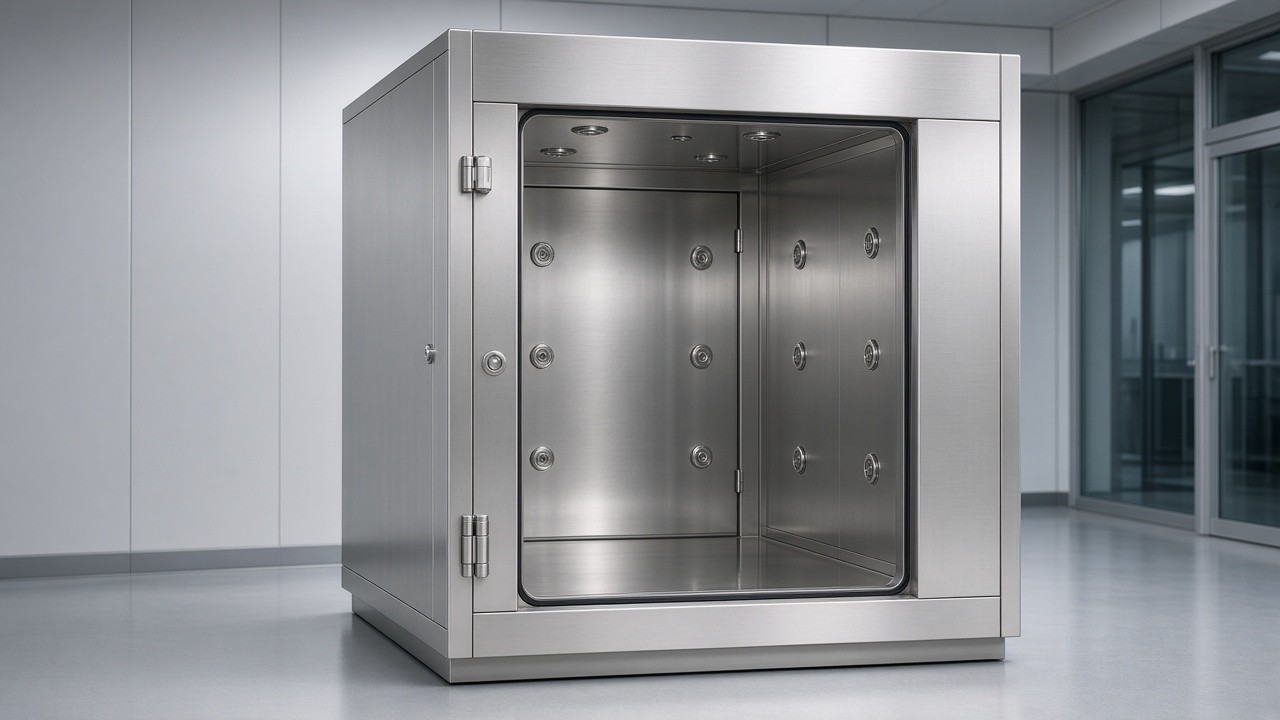
1 person
Controlled entry sequence per cycle
>22 m/s
Specified nozzle wind speed
H13 / ULPA
Filtration options to confirm for the project
Buyer Questions
Short answers before you select a supplier
A reliable single-person air shower supplier should help your team connect the application to measurable specifications—not simply offer a standard enclosure.
What determines the design?
Target cleanroom class, personnel flow, gowning process, available footprint, utilities, and the required entry cadence.
What does one cycle control?
The chamber manages nozzle coverage, blow time, filtered recirculation, and door sequencing for one person at a time.
Which standards matter?
ISO class, GMP, CE, or GB requirements may affect materials, controls, documentation, and validation scope. Confirm the applicable target during RFQ.
When is it the right format?
It suits intermittent or controlled movement in laboratories, pharmaceutical suites, and precision assembly areas.
Parameter Table
Baseline specifications for RFQ alignment
The values below describe the available standard configuration where stated. Final dimensions, utilities, airflow, controls, and documentation remain subject to model selection and project confirmation.
| Parameter | Specification details | RFQ status |
|---|---|---|
| External dimensions | Custom; standard 1400W × 1000D × 2180H mm | Confirm site fit |
| Internal dimensions | Custom; standard 800W × 900D × 1950H mm | Confirm user and gowning clearance |
| Capacity | 1 person per cycle | Standard configuration |
| Nozzle quantity | 12–24 adjustable stainless steel nozzles | Confirm layout and coverage |
| Nozzle wind speed | >22 m/s | Verify by test method |
| Filter grade | HEPA H13; ULPA available | Confirm required grade |
| Filtration efficiency | 99.99% at 0.3 μm for H13 configuration | Confirm certificate and test basis |
| Recirculation airflow | 800–1200 m³/h, depending on model | Model dependent |
| Blow time | Adjustable, 0–99 seconds | Set during commissioning |
| Door interlock | Electronic or electromagnetic; safety override included | Confirm logic and interface |
| Power supply | 220V/50Hz or 380V/50Hz; customizable | Confirm local utility |
| Housing material | SUS304 stainless steel or powder-coated cold-rolled steel | Confirm corrosion and cleanability needs |
| Control system | PLC with LCD touch interface | Confirm BMS signal requirements |
Deep-Dive Specifications
Performance is a system, not a single number
Nozzle geometry
The 12–24 adjustable stainless steel nozzles are arranged to address high-shedding areas such as shoulders, sides, and footwear. Confirm the final layout against garment type and required body coverage.
Filtered air cycle
High-velocity air is recirculated through the selected HEPA or ULPA configuration. Airflow volume and recovery behavior depend on the model, filter arrangement, and blow-time setting.
Interlock and controls
The dual-door sequence prevents simultaneous opening while the PLC manages cycle timing, alarms, and status. BMS outputs for door and alarm status are available to confirm during integration review.
Installation and acceptance planning
Installation
Check floor loading, ceiling height, FFU maintenance access, delivery route, and final door alignment before fabrication.
Factory acceptance
Request FAT records covering particle count data, nozzle velocity measurements, interlock operation, alarms, and control sequence.
Site validation
Agree the commissioning method, target cleanliness, blow-time settings, BMS signals, and documentation package before shipment.
Use-Case Examples
Match the chamber to the movement pattern
Pharmaceutical suites
Controlled gowning rhythm
A one-person cycle supports defined personnel entry, documented blow time, and interlocked transitions between gowning and higher-grade areas.
Electronics and precision assembly
Low-contamination access
A compact footprint can be integrated into an existing layout where entry is intermittent and the process requires repeatable personnel preparation.
Laboratories and regulated production
Traceable operating logic
PLC controls, door status, alarms, and acceptance records support engineering review and quality documentation.
Selection Boundary
Single-person air shower or air tunnel?
Choose according to throughput rather than product preference. A single-person air shower is intended for controlled movement of one person per cycle and usually offers a smaller footprint with easier integration.
Select this format for laboratories, pharmaceutical suites, and precision lines with intermittent or one-to-three-person movement.
Review an air tunnel when production requires high-volume, simultaneous entry, such as large groups entering a food-processing facility.
What to Verify Before Ordering
- 01Floor loading: verify support for the completed stainless steel or coated-steel structure.
- 02Ceiling clearance: allow for the top-mounted FFU and maintenance access.
- 03Power: confirm whether the site requires 220V or 380V compatibility.
- 04Compliance target: identify ISO, GMP, CE, or GB requirements and the documentation scope.
- 05Service route: check delivery access, installation sequence, and replacement-filter access.
FAQ
Questions procurement and engineering teams ask
What is the difference between H13 and ULPA filtration?+
H13 is specified at 99.99% efficiency at 0.3 μm in the baseline configuration. ULPA is available when the project requires a different filtration target; confirm the exact grade, efficiency test basis, and certificate during RFQ.
Can the unit replace an existing brand?+
Potentially. Replacement requires a review of external and internal dimensions, door handing, power, airflow, interlock logic, BMS signals, and the existing installation interface. A site drawing or current model number is needed for confirmation.
How can we verify a sample or delivered unit?+
Define acceptance criteria before production. Factory acceptance testing can include particle count data, nozzle velocity measurements, blow-time operation, door interlock checks, alarms, and control-interface verification. On-site validation support is available on request.
What is the lead time for standard and custom configurations?+
Standard units are typically ready for shipping within 15–20 days. Custom materials, dimensions, or PLC logic may require 30–45 days. Final timing is to be confirmed against the approved specification and quantity.
How should we request wholesale or project pricing?+
Submit the application, target standards, configuration requirements, quantity, destination, and requested delivery date. This allows CleanroomLink to quote the correct model rather than a generic Single-Person Air Showers price.
Quote Preparation
Send the project details behind your specification
For a precise quotation from CleanroomLink, please provide the application environment, target standards, required specifications, estimated quantity, destination, and expected delivery date. Include available floor space, ceiling height, power supply, material preference, and any BMS or validation requirements.
Email:
Address:
Technical inquiry
Share your project information and the CleanroomLink team will review the correct single-person configuration.