
Cargo transfer contamination control
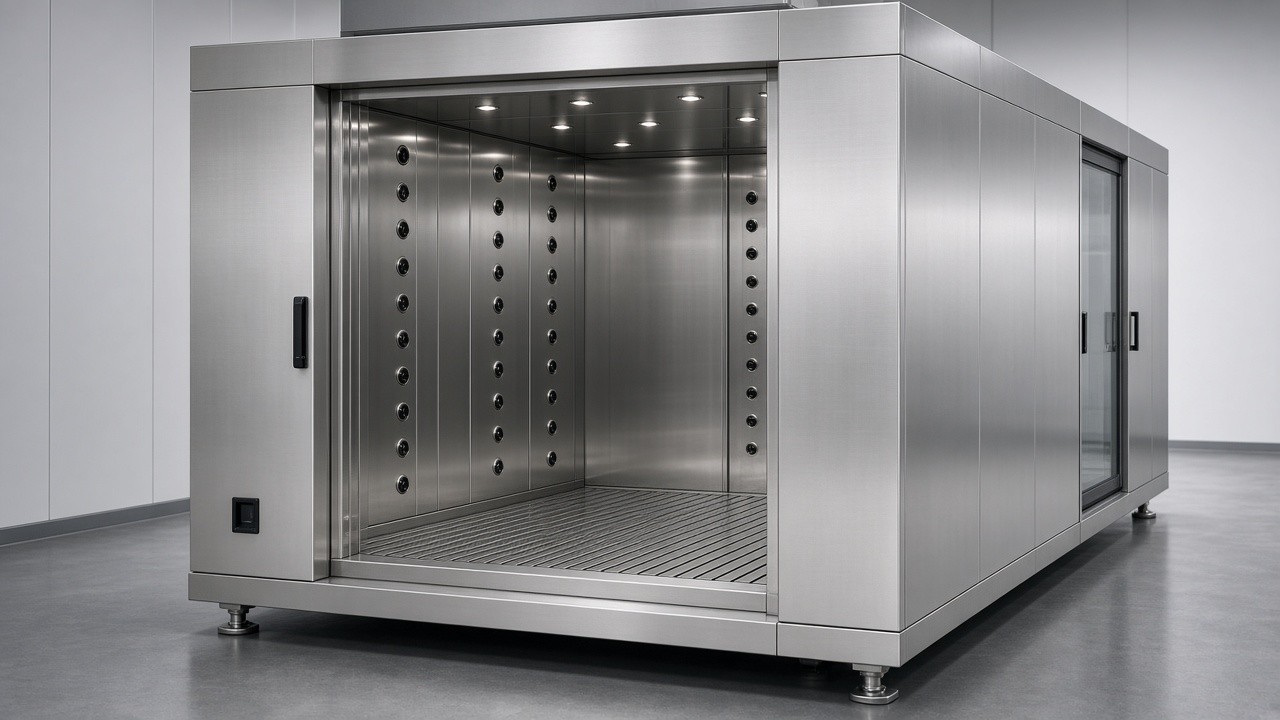
Industrial Cargo Air Showers engineered for controlled material flow
For facility managers, engineers, QA teams, and B2B procurement specialists, CleanroomLink configures Cargo Air Showers around the actual dimensions, throughput, standards, and documentation requirements of your project.
Start with verified specifications, sample-level design review, clear MOQ expectations, and a delivery plan that supports high-frequency movement of carts, pallets, AGVs, and raw materials into controlled environments.
Custom
Passage and chamber sizing
PLC
Programmable cycle control
QA
Evidence-led project handover
Compliance Path
Three decisions should shape the RFQ before the design begins
A cargo air shower is part of the facility logistics system, not an isolated enclosure. Confirm these inputs early so the proposed equipment can be matched to the process rather than adjusted after purchase.
Clear passage dimensions
Measure the maximum width and height of carts, pallets, and AGVs, including handles, packaging, and pallet overhang. The internal chamber must support the real load profile.
Material throughput velocity
Map transfer frequency, dwell time, door cycle requirements, and blower capacity to avoid creating a bottleneck in the production or warehouse route.
Compliance level
Identify the required ISO or GMP environment and destination-market electrical requirements, including CE, UL, or other regional standards for controls and filtration.
Required Evidence
Build the purchase around evidence, not only equipment
International procurement teams need a clear trail from approved configuration to installation and acceptance. CleanroomLink supports the project with engineering review, quality inspection, logistics coordination, and compliance verification.
Discuss your project evidence packageApproved configuration
Layout review, load dimensions, chamber arrangement, and controls specification.
Performance verification
Air velocity, pressure differential, and HEPA integrity records where specified for the project.
Material traceability
Mill test reports for applicable stainless steel components and agreed material documentation.
Market-ready controls
Electrical components and certification requirements aligned with the destination market.
Parameter Table
Cargo Air Shower specifications confirmed during engineering review
The values below define the configuration scope. Final dimensions, airflow, power, and acceptance criteria must be confirmed against the site layout, load profile, and destination requirements during the RFQ stage.
| Parameter | Specification scope | RFQ confirmation |
|---|---|---|
| External dimensions | Custom, based on site and load size | Required |
| Internal dimensions | Custom, based on cart, pallet, or AGV clearance | Required |
| Capacity / load limit | To be confirmed per project | Required |
| Nozzle quantity | Multi-nozzle, multidirectional configuration | Depends on model |
| Nozzle air velocity | 20–25 m/s, adjustable | Confirm by design |
| Filtration grade | HEPA H13/H14 where specified | Required |
| Filtration efficiency | 99.99% at 0.3 μm for stated HEPA configuration | Test scope to be agreed |
| Circulating airflow volume | Depends on chamber volume | Required |
| Blow-off time | 0–99 seconds, programmable | Confirm process cycle |
| Door interlock | Electronic or magnetic interlock | Required |
| Power supply | Custom voltage and phase by region | Required |
| Housing material | SUS304 stainless steel or powder-coated steel | Required |
| Control method | PLC with soft-touch interface | Depends on model |
Performance Match
Choose the transfer technology that matches the load
The right boundary between a Cargo Air Shower and a pass box is determined by the size, movement, and handling method of the material.
Cargo Air Showers
Large-load transfer- ✓Designed for personnel-accompanied carts, pallets, AGVs, and high-volume raw materials.
- ✓Uses multiple adjustable nozzles, significant circulating airflow, and timed blow-off cycles.
- ✓Requires floor-level planning, clear passage dimensions, and coordinated door interlocking.
Pass Boxes
Small-item transfer- •Better suited to small components, tools, samples, and raw materials that do not require vehicle access.
- •Typically installed into a wall and sized around manual item handling.
- •Not a substitute where pallet clearance, cart movement, or high material throughput is required.
Application Boundaries
Design around the logistics route, not just the enclosure
A custom Cargo Air Shower should be reviewed against the complete route from receiving or warehouse areas to the controlled room. This includes turning radius, floor conditions, door clearance, loading method, and the required dwell time.
Recommended fit
Controlled material transfer, palletized loads, carts, AGVs, and frequent production logistics.
Review carefully
Very high throughput where a programmed blow-off cycle could affect line balance or staffing.
Use another solution
Small components and tools that can pass through a wall-mounted pass box without vehicle or personnel access.
Confirm locally
GMP, ISO, CE, UL, regional electrical, pressure, and validation requirements before order release.
Documentation Checklist
Specify the handover package before production
Documentation requirements vary by project and destination. Add the required records to the quotation review so QA and compliance teams can plan acceptance without avoidable delays.
Material certificates
Mill test reports for applicable stainless steel components.
HEPA validation
DOP or PAO integrity test results where included in the agreed scope.
Electrical compliance
CE, UL, or local regulatory certification for the control system as required.
Operating manuals
Installation, operation, maintenance, and PLC programming documentation.
Calibration records
Air velocity and pressure differential test records where specified.
Project drawings
Approved layouts, interface points, and installation information available on request.
Frequently Asked Questions
Answers for technical procurement and project planning
How do I determine the right Cargo Air Shower size? +
Include the maximum cart, pallet, or AGV width and height, handles, overhang, turning requirements, and loading method in your RFQ. The chamber size is then reviewed against the required clearance and airflow path.
What is the MOQ? +
Single-unit project requirements are supported for new facilities and upgrades. Wholesale pricing can be reviewed for multi-unit or multi-site rollouts.
Can you provide a physical sample? +
Because of the equipment scale and engineering requirements, physical samples are not provided. Detailed technical datasheets, 3D CAD drawings, and virtual project consultations are available for design validation.
Can the system be customized for CE, UL, or regional standards? +
Yes, electrical components, materials, control panels, and documentation can be reviewed against the destination market. The exact certification scope must be confirmed during the RFQ and engineering review.
What is the lead time for custom-sized units? +
Standard units typically ship within 4–6 weeks. Complex, fully automated systems or projects requiring additional design validation and certification may require longer lead times.
Compliance-Focused RFQ
Ask for Technical Datasheet & Pricing
Send your cargo dimensions, target ISO or GMP environment, transfer frequency, destination port, preferred power supply, and required standards. Our team will review the application and prepare the next technical steps.
- ✓Internal and external passage dimensions
- ✓Cart, pallet, or AGV load information
- ✓Target airflow and cycle requirements
- ✓Certification and documentation needs
Start your project review
Share your requirements with the CleanroomLink team for a configuration review, technical datasheet, MOQ guidance, and pricing discussion.