
Cleanroom personnel transition engineering
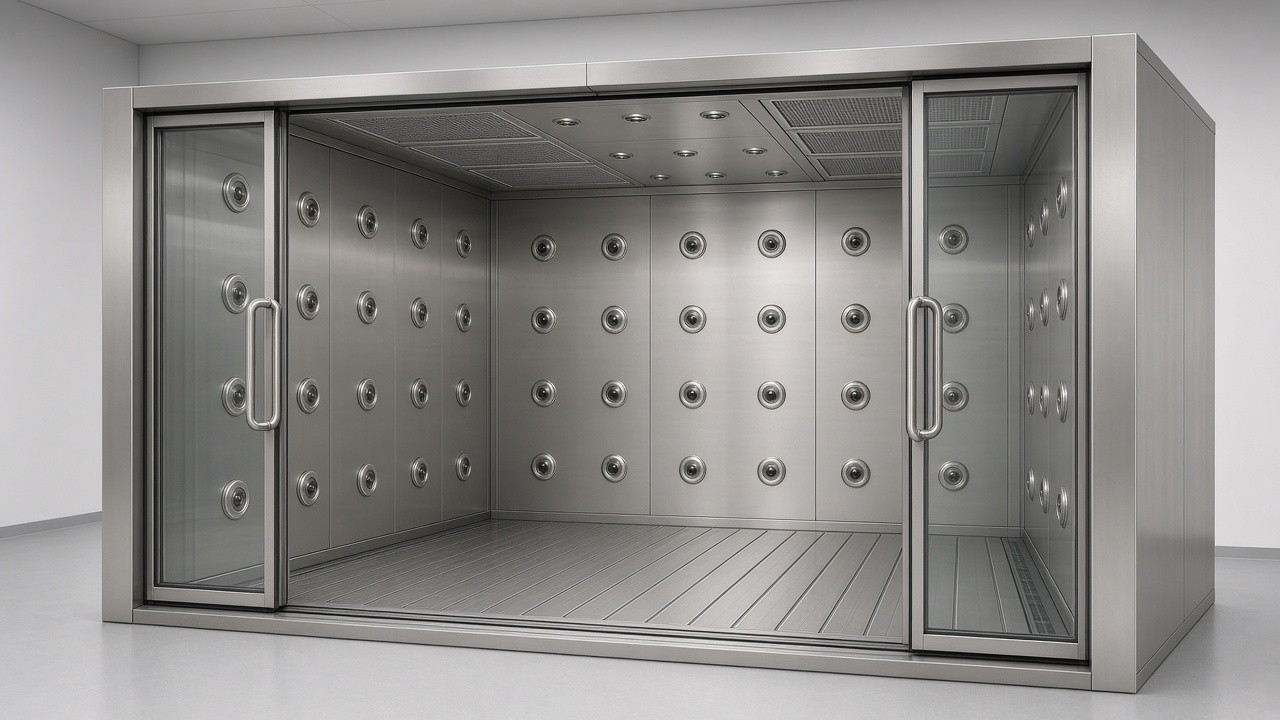
Multi-Person Air Showers for High-Throughput Cleanrooms
At CleanroomLink, we engineer multi-person air showers for overseas B2B projects where throughput, contamination control, and lifecycle cost must work together. The right specification helps reduce filter-related downtime, avoid premature replacement, and keep personnel moving through the cleanroom entrance.
2–8
Persons, depending on model
H13/H14
Filtration level options
RFQ-led
Dimensions and layout confirmed
Built around your facility
Final airflow, dimensions, controls, materials, installation interfaces, and compliance documentation are confirmed during the engineering review.
Engineering Overview
Throughput without treating contamination control as an afterthought
Multi-person air showers are designed for facilities where shift changes or production schedules bring groups of personnel to the cleanroom entrance at the same time. Extended internal dimensions and circulating airflow help reduce entry bottlenecks compared with single-user equipment.
The system uses high-velocity nozzles positioned around the personnel envelope to dislodge particulate matter before entry into the controlled zone. The engineering objective is not simply a high air volume; it is a balanced combination of nozzle coverage, filtration, door interlocking, cleanable construction, and maintainable access.
For a Multi-Person Air Showers supplier or manufacturer, project success also depends on how the equipment connects to your room layout, personnel flow, electrical system, commissioning plan, and quality records.
Design Factors
Decisions that influence installation, compliance, and lifecycle cost
A low purchase price can be outweighed by frequent filter changes, difficult cleaning, unplanned shutdowns, incompatible materials, or a layout that slows every shift. These are the design factors we review before a custom or wholesale order is finalized.
Interlocking efficiency
Electronic or magnetic interlocks prevent both doors from opening simultaneously, supporting separation between the grey zone and clean zone.
Material compatibility
SUS304, SUS316, or powder-coated steel configurations can be evaluated against cleaning agents, oxidation risk, and the requirements of pharmaceutical, electronics, and food-processing environments.
Airflow and coverage
Nozzle quantity, nozzle position, wind speed, circulation volume, and blow time must be considered together rather than selected as isolated specifications.
Modular scalability
A modular design can support future production growth and integration into an existing facility with minimal structural modification, subject to a layout review.
Parameter Table
Multi-person air shower specifications
The values below are an engineering reference. Exact dimensions, airflow, controls, and materials must be confirmed against your cleanroom classification, personnel flow, site utilities, and RFQ documentation.
| Parameter | Reference specification | RFQ confirmation |
|---|---|---|
| External dimensions | Custom / To Be Confirmed | Required |
| Internal dimensions | Custom / To Be Confirmed | Required |
| Capacity | 2–8 persons, scalable | Confirm personnel flow |
| Nozzle quantity | 24–72, layout dependent | Confirm body coverage and layout |
| Nozzle wind speed | ≥ 22–25 m/s | Confirm test method |
| Filtration level | HEPA H13/H14 | Confirm project requirement |
| Filtration efficiency | 99.99% @ 0.3 μm | Confirm applicable report |
| Circulation volume | 1200–4000 m³/h | Depends on model |
| Blow time | 0–99 seconds, adjustable | Confirm operating sequence |
| Door interlock | Electronic / magnetic | Confirm control interface |
| Power supply | 380V / 3Ph / 50Hz, or as requested | Required before quotation |
| Box material | SUS304 / powder-coated steel | Confirm cleaning compatibility |
| Control system | PLC with LCD interface | Confirm language and signals |
Operating Limits
Define the application boundary before you place an order
Intended use
Personnel air-lock transition before entry into a controlled zone, especially where several people need to pass through during shift changes.
Not a replacement system
The unit is not a substitute for primary HEPA filtration or a complete cleanroom HVAC system.
Moisture exposure
High-moisture environments require specific review and may need marine-grade coatings or other custom protection.
ISO classification
Fan speed, nozzle configuration, and filtration grade can be reviewed for ISO Class 5 to 8 environments.
Comparison Guide
Choose the right equipment for the movement you need to control
Personnel transition
Multi-Person Air Showers
Optimized for groups of personnel entering a controlled area, with configurable dimensions and a timed air-cleaning cycle.
Continuous movement
Air Tunnels
A more appropriate choice where people or products require continuous, conveyor-based flow rather than a discrete air-lock cycle.
Material transfer
Pass-Through Boxes
Designed for material transfer between rooms. They should not be used as a substitute for personnel air showers, or the two functions may create compliance gaps.
Quality Validation
Verification that follows the specification fields
After the model and RFQ parameters are agreed, the validation plan can be mapped to the equipment configuration and your QA/QC requirements.
Airflow performance
Test reporting can cover nozzle wind speed uniformity and the agreed circulation conditions.
Particle control
Particle count testing can be considered according to the project acceptance plan.
Electrical safety
Electrical safety documentation is prepared according to the agreed equipment and market requirements.
Applicable standards
CE, ASTM, local GB standards, or other requirements are reviewed during the initial design phase. Certification availability is confirmed per project.
Installation and Acceptance
Treat procurement as an equipment engineering project
Layout review
Confirm external and internal dimensions, door direction, personnel flow, grey-zone and clean-zone interfaces, and site access.
Utility and controls review
Confirm power supply, PLC/LCD requirements, interlock logic, alarm signals, and any facility integration points before manufacture.
Installation guidance
Installation manuals and remote technical guidance are provided. Large-scale projects can be coordinated with local partners for on-site commissioning.
Acceptance plan
Align acceptance records with the agreed airflow, particle, electrical, interlock, and documentation requirements.
Maintenance / Replacement
Plan service around actual use, not a fixed guess
Total cost of ownership is shaped by personnel throughput, facility air quality, cleaning practices, filter saturation, energy use, and the downtime required to service the unit. A filter replacement interval cannot be responsibly fixed without operating data.
- Tool-less access panels support HEPA filter replacement and routine service.
- An integrated pressure gauge helps maintenance teams monitor filter saturation and plan proactive replacement.
- A recommended spare-parts list can be supplied with each shipment, including pre-filter and HEPA filter planning.
- Cleaning-agent compatibility and replacement access should be confirmed during the RFQ stage.
Documentation
Give procurement, engineering, and QA one consistent record
Documentation requirements should be defined before production so the selected Multi-Person Air Showers manufacturer can align drawings, reports, manuals, and market-specific standards with your approval process.
Technical submittal
Dimensions, airflow, nozzle arrangement, materials, controls, and utilities.
Test reports
Nozzle wind speed uniformity, particle count testing, and electrical safety records as agreed.
Installation package
Installation manuals, operating guidance, and commissioning support information.
Spare-parts planning
Recommended consumables and replacement planning for pre-filters and HEPA filters.
FAQ
Questions buyers ask before confirming specifications
Can the system be customized for a specific cleanroom ISO class? +
Yes. Fan speed, nozzle configuration, and filtration grade can be reviewed for ISO Class 5 to 8 environments. The final configuration depends on your facility requirements and must be confirmed during RFQ engineering.
How often do HEPA filters need to be replaced? +
Replacement frequency depends on facility air quality, personnel throughput, cleaning, and pressure-gauge readings. The integrated pressure gauge supports proactive maintenance rather than a universal fixed interval.
Is a multi-person air shower compatible with an existing cleanroom? +
Compatibility is assessed through a layout and utility review covering dimensions, door interfaces, power supply, personnel flow, pressure relationships, and control signals. Existing conditions should be provided with the RFQ.
Can you support batch or wholesale procurement? +
Yes. Batch quantities, repeated layouts, spare-parts requirements, pre-production inspection, and shipment documentation can be reviewed as part of a wholesale or multi-site project.
Do you provide installation support and project documents? +
Installation manuals and remote technical guidance are available. For large-scale projects, local-partner coordination for on-site commissioning can be discussed. Required standards and certification documents are confirmed per project.
Talk to an Engineer
Request a Sample + Quote for your next cleanroom project
Send your layout, required capacity, target ISO class, utilities, preferred materials, destination market, and documentation needs. First-time buyers can request sample verification, while project teams can proceed directly to a detailed technical quotation.
Project inquiry
Share your technical requirements and our team will review the appropriate configuration.
Email:
Address: