
Cleanroom storage engineering
Stainless Steel Cabinets for Controlled Environments
CleanroomLink provides industrial-grade stainless steel storage solutions for cleanroom, pharmaceutical, food processing, and high-precision manufacturing environments. Each cabinet is designed around cleanability, structural integrity, material selection, and project-specific compliance requirements.
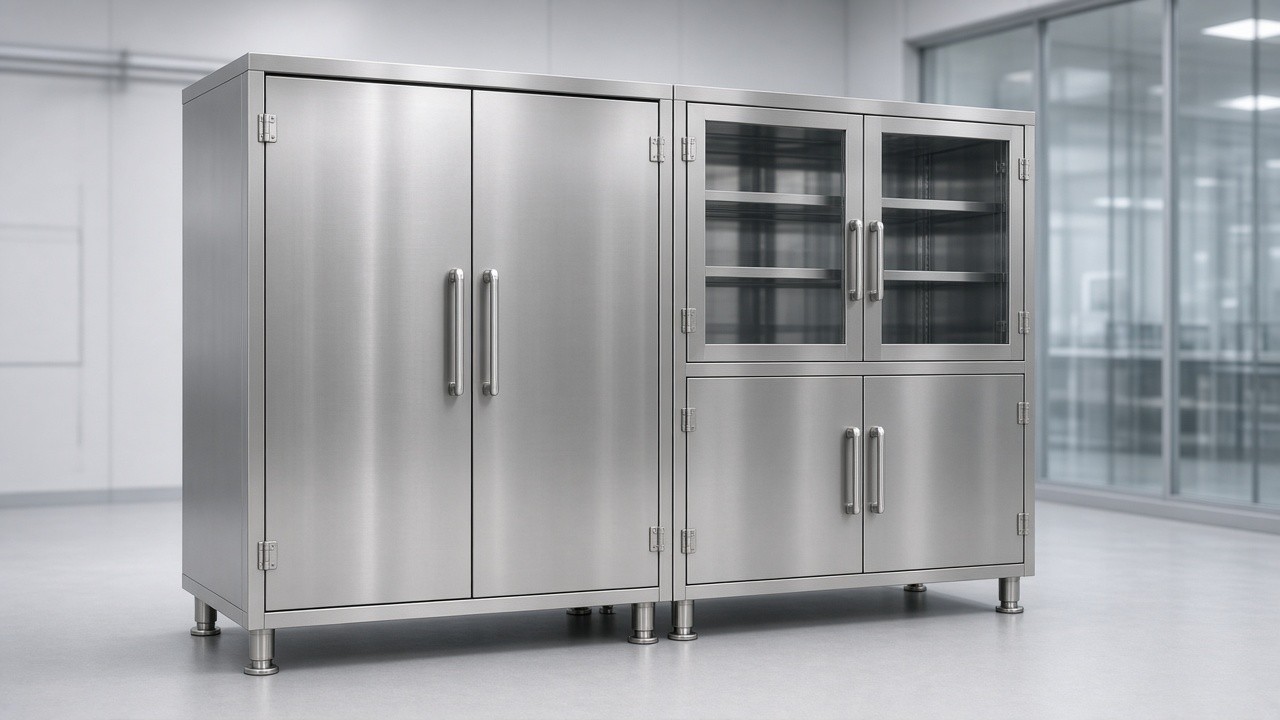
Designed for procurement review
Material grade, finish, configuration, installation, and documentation can be confirmed during the RFQ stage.
Best for
- Cleanroom operations: Facilities planning storage for ISO Class 5–9 environments, subject to project validation.
- Regulated manufacturing: Pharmaceutical, biotech, food processing, and medical device operations requiring cleanable and corrosion-resistant furniture.
- Custom projects: Procurement teams needing specific dimensions, pass-through designs, ESD provisions, or modular layouts.
Not ideal for
- General office storage: Low-cost, non-hygienic storage for standard office supplies.
- Outdoor or uncontrolled environments: Non-sanitary outdoor tool storage or applications requiring separately engineered weather protection.
- Off-the-shelf retail: Immediate small-quantity shipment of generic, non-customizable furniture.
01 · Buyer fit
Who this stainless steel cabinet service is for
This service is intended for overseas B2B buyers who need more than a standard cabinet catalogue. Engineering, quality, and facility teams can align the cabinet structure with cleaning protocols, room classification, production flow, and future expansion plans.
Procurement teams
Compare a stainless steel cabinets supplier by material traceability, customization scope, packaging, and RFQ responsiveness.
Cleanroom engineers
Coordinate cabinet dimensions, pass-through layouts, wall interfaces, grounding, and installation constraints.
QA and compliance
Request material certificates, test reports, finish information, and design records for internal or external audits.
Factory managers
Plan durable storage for consumables, garments, components, tools, and production-line support materials.
02 · Selection boundary
Who should choose another option?
Stainless steel cabinets are selected for cleanability, chemical resistance, and controlled-environment compatibility. They may not be the most economical choice where hygiene, corrosion resistance, or custom engineering is not part of the requirement.
Office or dry storage
Powder-coated steel or general-purpose furniture may offer a lower total purchase cost for ordinary office supplies outside controlled areas.
Outdoor tool storage
Uncontrolled outdoor applications require a separate weatherproofing and security specification rather than a cleanroom-focused cabinet design.
Immediate retail purchase
A custom stainless steel cabinets manufacturer is better suited to project quantities, drawings, and staged production than instant retail fulfilment.
03 · Product structure
Built around cleanable structure and space control
The cabinet design can be developed around the room layout, storage workflow, cleaning method, and required access points. Final engineering drawings confirm the dimensions, load path, joining method, and hardware before production.
- Material: AISI 304 is suitable for many cleanroom applications; 316L can be specified for more aggressive chemical or saline environments.
- Joints: TIG-welded and ground-smooth construction is used to reduce crevices and simplify wipe-down procedures.
- Interior: Shelves, drawers, sliding or swing doors, pass-through access, and modular banks can be coordinated with the storage plan.
- Base: Adjustable leveling feet or medical-grade casters support different installation and mobility requirements.
Technical specifications and parameter table
Final values are confirmed against approved drawings and the RFQ.
| Parameter | Specification / RFQ status |
|---|---|
| 主体材质 / Material | AISI 304 or 316L stainless steel; grade to be confirmed. |
| 表面处理 / Surface finish | Brushed, typically Ra ≤ 0.8 µm, or electropolished, typically Ra ≤ 0.4 µm; final value to be confirmed. |
| 尺寸 / Dimensions | Custom width, depth, and height per site requirements. |
| 承载能力 / Load capacity | Depends on model and internal frame design; shelf capacity to be confirmed. |
| 配置 / Configuration | Shelves, drawers, sliding or swing doors, pass-through, and cabinet banks; custom. |
| 台面结构 / Top structure | Depends on cabinet application and adjoining work surface; available on request. |
| 脚轮 / 调节脚 | Adjustable leveling feet or medical-grade casters; selection to be confirmed. |
| ESD performance | Optional anti-static grounding connections; test requirements to be confirmed. |
| 洁净等级 / Cleanroom rating | Suitable for ISO Class 5–9 applications when specified and validated for the project. |
| 耐腐蚀性 / Corrosion resistance | High; 316L recommended for aggressive chemical environments. |
| 定制选项 / Custom options | Dimensions, layout, doors, pass-throughs, finish, grounding, and modular integration; custom. |
| 安装方式 / Installation | Freestanding, wall-mounted, or modular bank; site interface to be confirmed. |
04 · Performance priorities
The details that affect cleanability and service life
Material integrity
Certified stainless steel sheets can be specified. 304 is common for cleanroom use, while 316L is considered for aggressive cleaning agents or saline exposure to reduce pitting risk.
Crevice-free construction
TIG-welded, ground-smooth joints and radius corners where possible help reduce contamination traps, sharp internal corners, and cleaning effort.
Surface treatment
A uniform brushed finish is commonly used for standard cleanrooms. Electropolishing can reduce microscopic irregularities and support demanding sanitation requirements.
05 · Applications
Where custom stainless steel cabinets are used
The correct configuration depends on the process, cleaning regime, environmental exposure, and access pattern.
Pharmaceutical and biotechnology
Storage for gowns, consumables, and small-batch components, with designs that can be reviewed for VHP decontamination requirements.
Electronics and semiconductor
ESD-oriented storage for sensitive components using grounding points and static-dissipative provisions where required.
Food processing
Corrosion-resistant storage for tools and equipment in humid or wash-down environments, subject to the site cleaning specification.
Medical device assembly
Crevice-conscious cabinetry for cleanroom assembly lines, component control, and organized point-of-use storage.
06 · Standards and documentation
Documentation that supports technical review
Manufacturing and documentation requirements should be agreed during the RFQ. Available records depend on the model, material, finish, and project scope.
GMP / cGMP considerations
Design discussions can address surface finish, cleanability, and contamination-control expectations.
ISO 14644 compatibility
Cabinet materials and particulate-generation considerations can be reviewed for the intended cleanroom class; final suitability requires project validation.
ASTM / EN material records
Material test reports and mill certificates for 304 or 316L can be requested to verify chemical composition and traceability.
07 · Packaging and MOQ
Plan delivery around your rollout
- Packaging: Protective film with fumigation-free wooden crates or reinforced cardboard packaging, selected to reduce transit damage.
- MOQ: Pilot projects and larger facility rollouts can be discussed; MOQ depends on customization level.
- Lead time: Confirmed after final drawings, approved specifications, and production capacity review.
- Export documents: Required documents and packing details should be listed in the RFQ for confirmation.
08 · Adjacent product choice
Stainless steel versus general-purpose steel
Stainless steel cabinets are usually preferred when corrosion resistance, frequent sanitation, smooth cleanable surfaces, and controlled-environment compatibility matter. General-purpose powder-coated steel may be more economical for dry offices, ordinary warehouses, or applications without strict hygiene requirements. The right option depends on cleaning chemicals, humidity, room classification, and lifecycle expectations.
Discuss the right specification09 · FAQ
Questions from B2B buyers and QA teams
Can you provide stainless steel grade certificates?
Material mill certificates and related records can be requested for AISI 304 or 316L orders. The exact documentation package is confirmed during the RFQ.
Are test reports and audit documents available?
Test reports, material certificates, and design specifications may be included according to the approved project scope. Required records should be identified before production.
How is batch-to-batch consistency managed?
Raw-material traceability and approved drawings support consistency across multi-phase projects. Surface finish and structural details should be locked in the technical specification.
What packaging is used for export shipments?
Units are protected with film and packed in fumigation-free wooden or reinforced cardboard packaging. Export packing, labelling, and document requirements are confirmed per destination.
Is installation support available?
Installation diagrams are available, with remote or on-site guidance for complex modular assemblies available on request.
Which information is needed for an accurate quote?
Please provide dimensions, ISO class or environment, material grade, finish, configuration, load expectations, installation method, quantity, delivery destination, and documentation needs.
10 · Request pricing
Request a Sample + Quote
Start with a sample if you need to verify material, finish, weld quality, or cleaning compatibility before committing to a larger rollout. For project pricing, send your cabinet schedule or preliminary drawings for technical review.
Email:
Office:
Send your project requirements
Include dimensions, environment, preferred grade, finish, configuration, quantity, and destination.