
Cleanroom PPE sourcing and specification matching
Industrial Cleanroom Aprons for Controlled Production
A food processing apron must manage fats, oils, and hygiene requirements. A semiconductor cleanroom apron must control particulate release and may require ESD performance. The right material, construction, and documentation depend on the operating environment.
At CleanroomLink, we help overseas procurement teams, engineers, QA specialists, and factory managers source aprons against defined technical and compliance requirements.
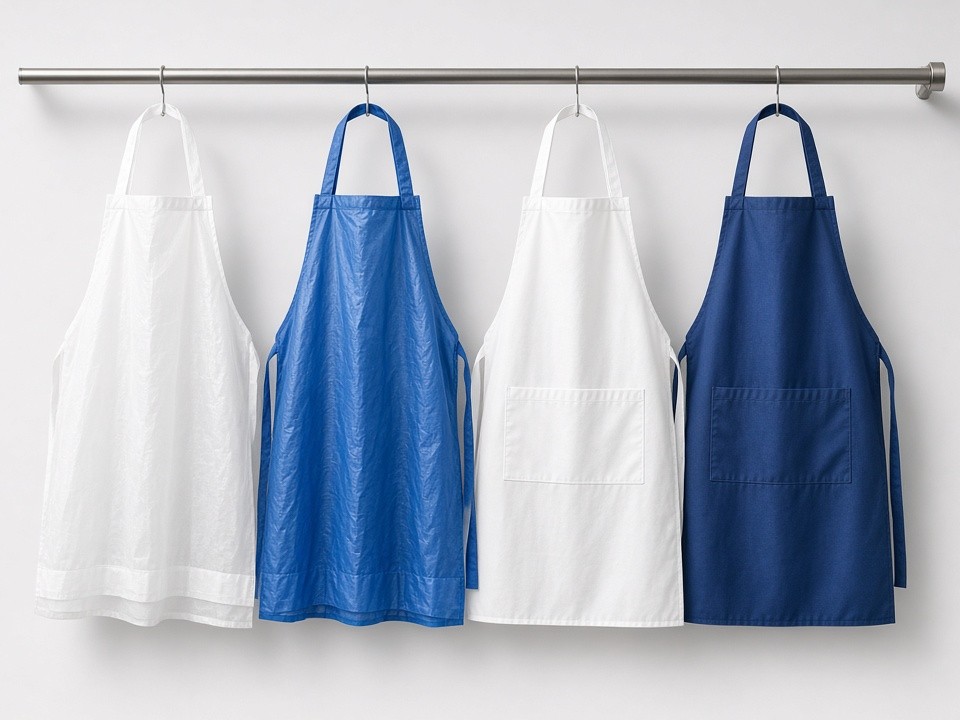
Food processing
Liquid and oil barrier, hygiene documentation, and application-specific material selection.
Semiconductor cleanroom
Low-linting construction, particulate control, and ESD requirements where applicable.
Alternative sourcing
Keep production moving without lowering the specification
Global supply interruptions and brand-dependent procurement can make recurring PPE unnecessarily expensive. We act as an extension of your procurement team, identifying alternative manufacturers that align with your current technical requirements.
01
Map the requirement
Review the existing SKU, datasheet, sample, ISO class, chemical exposure, ESD needs, and packaging controls.
02
Match qualified sources
Compare multi-manufacturer options by material, construction, documentation, and commercial fit rather than stock availability alone.
03
Validate before scale-up
Use samples and available test documentation to support internal QA review before a recurring order or replacement approval.
Match existing product
Replace an apron SKU with an equivalent or improved option
Send a technical data sheet or physical sample of the apron currently in use. Our team reviews the fabric composition, seam construction, and certification history to identify a replacement that fits your operating controls.
The review focuses on the metrics that matter to engineering and QA teams:
- ✓Fabric weave and density
- ✓Tensile strength and tear resistance
- ✓Surface resistivity for ESD variants
- ✓Autoclave compatibility for reusable options
RFQ preparation
Information that accelerates a technical match
Current product evidence
Part number, specification sheet, photographs, or a physical sample.
Operating conditions
Industry, cleanroom class, liquid or chemical exposure, and wearer workflow.
Quality requirements
Required EN, ASTM, GB, food-contact, ESD, sterility, or traceability documentation.
Apron specifications
Parameter table for model selection
The fields below connect the apron structure to the procurement decision. Exact values depend on the selected model and must be confirmed during the RFQ stage.
| Parameter | Specification options | RFQ note |
|---|---|---|
| Material | PE, CPE, PP, SMS, poly-cotton, conductive carbon fiber | Depends on model and exposure |
| Fabric structure | Non-woven, woven, microporous film | Confirm barrier and linting priorities |
| Basis weight | 25gsm–80gsm | Customizable; exact value to be confirmed |
| Closure system | Ties, snap buttons, hook-and-loop | Select for workflow and gowning procedure |
| Cuff / neck design | Elastic, adjustable, fixed | Custom or model-dependent |
| Size | S, M, L, XL, XXL; custom dimensions | Confirm body coverage and size range |
| Color | White, blue, yellow, custom | Available on request |
| Sterility | Non-sterile, sterile EO/Gamma | Confirm process and documentation required |
| Usage type | Disposable, reusable laundry-durable | Reusable cycle count: to be confirmed |
| ESD capability | Standard or dissipative; conductive carbon fiber option | Confirm required surface resistivity |
| Suggested ISO class | ISO 5–ISO 8 | Suitability depends on full garment system |
| Packaging | Bulk, individually wrapped, cleanroom-packed | Confirm packing room and presentation |
Specific values, test reports, certificates, and applicable EN, ASTM, or GB standards are available on request and should be confirmed before approval.
Equivalent vs. improved
Choose the replacement path that fits your validation strategy
Equivalent sourcing
ContinuityMatch the current material composition, construction, and performance profile to reduce changes to SOPs and validation requirements.
Improved performance
OptimizationAddress poor durability, excessive linting, or wearer discomfort through alternative fabric weights or seam-sealing approaches. Any improvement remains subject to your internal validation.
Validation plan
Build evidence before mass adoption
For each order, supporting documentation can be requested according to the product model and target market.
- 1
Certification verification
Review available CE, EN, ISO, or other applicable documentation.
- 2
Batch traceability
Request documentation linking the product to its production lot.
- 3
Third-party testing
Access independent reports for relevant material performance, such as bacterial filtration or particle release testing, when available.
- 4
On-site sample validation
Evaluate fit, donning procedure, contamination controls, and line performance before approval.
Commercial comparison
A procurement model built around technical fit
| Capability | Traditional distributor | CleanroomLink |
|---|---|---|
| Product range | Limited to specific brands | Multi-manufacturer and multi-spec sourcing |
| Certification approach | Brand-dependent | Compliance-driven by required standards |
| Pricing model | Fixed or higher markup | Supply-chain optimized |
| Technical support | Sales-focused | Engineering and QA-focused |
| Customization | Minimal | Size, material, packaging, and branding options |
Frequently asked questions
Clarify the boundary between aprons and adjacent products
What is the difference between an apron and a full gown?
An apron is primarily a liquid-protection or secondary layer over standard uniforms. A full gown provides broader coverage and may be required in higher ISO-class environments such as ISO 5 or ISO 6. The correct choice depends on your particulate-control strategy and gowning procedure.
Can you provide ESD-safe aprons?
ESD variants can be sourced with conductive carbon filaments or other specified constructions. Please provide the required surface resistivity in ohms per square, cleanroom class, grounding method, and adjacent equipment requirements for review.
How do I confirm food-grade suitability?
Material and documentation requirements vary by application. Tell us whether the environment is meat processing, bakery, dairy, or another operation so the material and available food-contact documentation can be assessed against your requirements.
Should I choose disposable or reusable aprons?
Disposable models support controlled replacement and may suit high-throughput operations. Reusable models require laundry, sterilization, and durability validation. The allowable reuse count is model-dependent and must be confirmed during the RFQ.
Replacement RFQ
Request a sample first, or move directly to a technical quote
Share your current product information and target operating conditions. We can support an initial sample evaluation or prepare a competitive proposal for an equivalent or improved replacement.
- 1.Current part number, specification sheet, or material and weight description
- 2.Target industry and ISO class
- 3.Annual volume or order quantity
- 4.Required certifications or standards, including EN, ASTM, or GB where applicable
Email:
Phone:
Address:
Start your apron evaluation
Use the contact path below to request a sample, submit an RFQ, or provide an existing apron for specification matching.