
Technical selection guide
ESD Shoe Covers selected for your cleanroom risk profile
Choose the correct specification by matching four factors: ESD grounding, cleanliness, slip control, and mechanical risk. CleanroomLink helps procurement teams, engineers, quality professionals, and factory managers source the right disposable or reusable ESD shoe cover for each production zone.
First decision
Disposable or reusable?
RFQ checkpoint
Resistance range and standard
01 / Buyer’s shortlist
Define the operating environment before choosing the cover
The right ESD shoe covers supplier will ask about the production zone, not just the shoe size. Use these questions to narrow the specification before requesting wholesale or custom pricing.
Cleanliness level
Confirm whether the area is ISO Class 5, 7, or 8 and whether particle shedding is controlled by your internal procedure.
ESD requirement
State the required surface resistivity range, such as 106 to 109 ohms, and the test method your QA team accepts.
Safety exposure
Separate slip, liquid splash, abrasion, impact, and puncture risks. An ESD cover may address only some of these risks.
Usage cycle
Select disposable covers for high-turnover areas or reusable, launderable polyester models where controlled repeat use is required.
02 / Must-have specifications
Build a continuous ESD and contamination-control path
For ESD compliance, the construction must support a reliable path between the wearer, the cover, and the ESD floor. For cleanroom use, the textile must limit lint and particle release.
Integrated conductive strip
A conductive ribbon should maintain contact from the wearer’s sock area to the floor. Attachment quality and continuity should be verified by the batch test method.
Low-lint material integrity
Conductive polyester or specialized non-woven composites may be suitable, depending on the required cleanliness class and use cycle.
Stable antistatic performance
Ask whether conductivity relies on a durable material treatment or a topical coating that may degrade after washing, storage, or repeated handling.
03 / Nice-to-have specifications
Improve fit, movement, and visual control
- ●Elasticized openings: A secure fit across different footwear reduces slipping, loose fabric, and trip risk.
- ●Textured soles: Enhanced grip can support safer movement on epoxy or vinyl cleanroom floors.
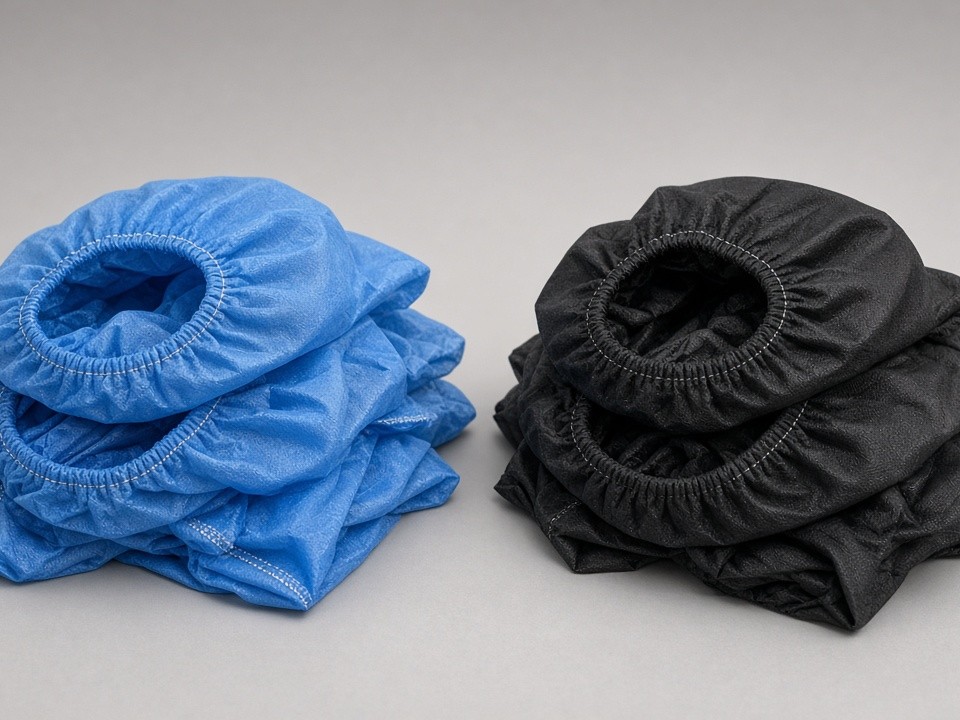
- ●Color coding: Blue, white, or custom colors can help separate general areas from critical zones.
- ●Custom branding: Confirm artwork, color, minimum order quantity, and delivery timing during the RFQ.
04 / Parameter table
ESD Shoe Covers specifications to confirm at RFQ
The values below describe the selection framework. Model-specific values, test reports, tolerances, and certificates must be confirmed before purchase.
| Parameter | Specification / RFQ status |
|---|---|
| Shoe upper material | Conductive polyester / non-woven polypropylene; confirm composition by model |
| Sole material | Textured or standard sole construction; material and thickness to be confirmed |
| Slip resistance | Enhanced grip / standard; required rating and test method to be confirmed |
| Surface resistance / ESD | Target range may include 106–109 ohms; exact range and test method to be confirmed |
| Impact protection | Not inherent to standard shoe covers; dedicated safety footwear required where applicable |
| Puncture protection | Not inherent to standard shoe covers; assess separately for the work zone |
| Water resistance | Depends on model; splash resistance and test method available on request |
| Cleanliness level | ISO Class 5 to 8, model dependent; particle data to be confirmed |
| Size | Universal or custom sizing available; footwear range and tolerance to be confirmed |
| Color | Standard or custom color; blue and white zoning options available on request |
| Disposable / reusable | Both formats available; only specified reusable polyester models are intended for laundering |
| Applicable standards | ANSI/ESD S20.20, IEC 61340-4-3, EN, ASTM, CE documentation: confirm required standard and evidence by model |
RFQ note: request batch-specific surface resistance reports, dimensional tolerances, cleanliness evidence, and any required Certificate of Conformance.
05 / Quality verification
Make testing correspond to the fields in your purchase specification
CleanroomLink manages sourcing against defined material and compliance requirements. Your RFQ should identify the evidence needed for release approval.
Conformance
Request a Certificate of Conformance for the agreed model and order.
Resistance
Request batch-specific surface resistance and conductive-strip test reports.
Particles
Request particle emission or cleanliness summaries where ISO classification applies.
06 / Red flags
Do not approve an “ESD” label without supporting evidence
01
Topical-only antistatic treatment
Sprays or surface coatings may lose effectiveness after washing, handling, or storage. Ask how performance is maintained.
02
Interrupted conductive path
A poorly attached conductive strip can create a blind spot between the wearer and the ESD floor.
03
High particle shedding
Standard fabric covers may not be appropriate for ISO-controlled areas. Require cleanliness evidence for the intended class.
07 / Applications and boundaries
Match the cover to the process, not just the product name
Electronics and semiconductors
Use ESD-focused construction to help protect sensitive components during assembly and controlled handling.
Medical device manufacturing
Prioritize low-lint materials and the required cleanliness process while maintaining personnel ESD controls.
Precision manufacturing
Combine contamination control, fit, traction, and batch verification for high-sensitivity production areas.
Selection boundary
ESD shoe covers are not ESD safety shoes
Standard shoe covers do not automatically provide steel or composite toe protection, puncture resistance, or high-voltage insulation. If the facility requires impact protection or dedicated protective footwear, transition to full ESD-rated safety shoes instead.
Discuss the boundary with a specialist →08 / FAQ
Answers for procurement, quality, and facility teams
Can ESD shoe covers be laundered?
Only specified reusable polyester models are designed for laundering. Disposable non-woven versions may lose structural integrity and conductive performance if washed.
How should we define the required cleanroom level?
State the target ISO Class 5, 7, or 8 environment and request model-specific particle or cleanliness evidence. The correct grade is model dependent.
How do we ensure a secure fit?
Confirm the footwear range, opening dimensions, and elastic tension. A high-elasticity option may be appropriate where the team uses varied footwear.
Which tolerances should be included in the RFQ?
Request size range, opening and sole dimensions, conductive-strip placement, resistance limits, color tolerance, and packaging requirements. Exact tolerances are to be confirmed by model.
What should quality acceptance cover?
Define surface resistance, continuity, appearance, dimensions, particle evidence, packaging, and the required Certificate of Conformance before production release.
Can custom color or branding be supplied?
Custom color and branding are available on request. Include artwork, target quantity, color requirements, and delivery timeline so the manufacturer can confirm feasibility.
09 / Compare options
Get a standard and upgraded proposal for your facility
Tell us your budget, target standard, cleanroom class, and operating risks. We can compare a cost-optimized standard option with an upgraded, certified option for critical environments.
Standard option
For controlled, high-volume consumption with defined core requirements.
Upgraded option
For critical environments requiring additional documentation or customization.
Include these details in your inquiry
- 01Target ISO class or contamination threshold.
- 02Required ESD resistance range, test method, and applicable standard.
- 03Estimated monthly or annual volume and disposable/reusable preference.
- 04Slip, liquid, abrasion, impact, or puncture risks that must be addressed.
- 05Size range, color, custom branding, delivery timeline, and budget target.