
Mobile Clean Units for B2B Manufacturing
Flexible contamination control for changing production environments
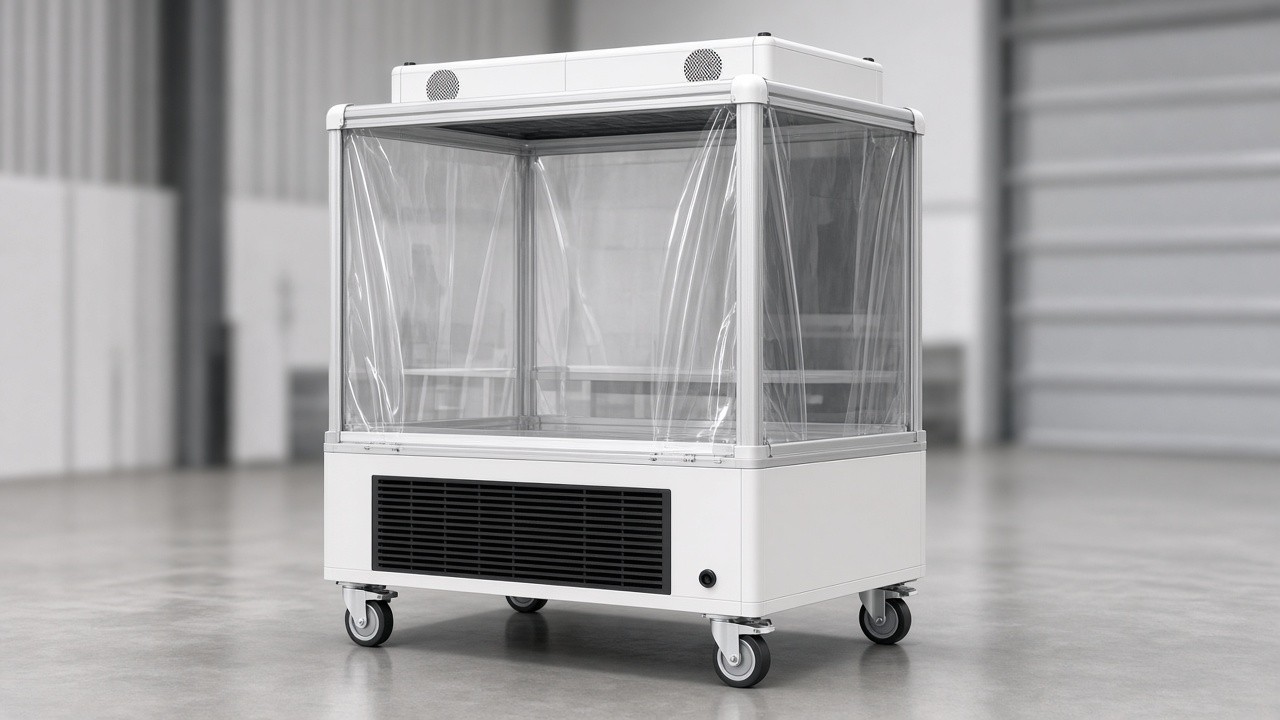
CleanroomLink helps overseas procurement teams, engineers, quality professionals, and factory managers source mobile clean units matched to real site conditions—not just a standard catalog model.
Engineering-first sourcing
Match airflow, workspace cleanliness, materials, controls, and compliance documentation before requesting a commercial proposal.
Alternative Sourcing
Beyond standard distribution
Fixed cleanroom infrastructure can be inefficient when production layouts change, facilities are leased, or a new process needs controlled space quickly. CleanroomLink works as an engineering-focused integrator, connecting your requirements with suitable manufacturing and supply-chain partners.
Site-fit sourcing
Account for footprint, ceiling clearance, entry routes, floor surfaces, production lines, and relocation needs.
Application matching
Select a mobile laminar flow booth, clean bench, or portable cleanroom configuration according to the controlled zone required.
Compliance planning
Map documentation and testing needs to applicable ISO, EN, CE, UL, GMP, FDA, or local requirements during technical review.
Match Existing Product
Define the variables before selecting the model
A reliable mobile clean unit supplier starts with the interaction between the facility, process, and equipment interfaces. These three variable groups form the basis of a technical match.
Design variables
- Dimensions: Footprint, overall height, and clearance height.
- Mobility: Caster load capacity, locking, and floor compatibility.
- Materials: SUS304/316, powder-coated steel, or aluminum profile according to washdown and process needs.
Process variables
- Cleanliness: Target ISO 5–ISO 8 particulate conditions, subject to validation.
- Airflow: Unidirectional flow for critical work or turbulent flow for general controlled areas.
- Filtration: HEPA H13/H14 or ULPA selection based on particle requirements.
Interface variables
- Power: Voltage, frequency, plug type, and control panel integration.
- Exhaust: Recirculating or single-pass airflow configuration.
- Connectivity: PLC/BMS integration or local alarms for filter and system status.
Engineering Specifications
A procurement-ready specification framework
The following fields are used to compare available configurations. Final values, testing scope, and documentation are confirmed during RFQ and engineering review.
| Parameter | Specification / RFQ status |
|---|---|
| Equipment Type | Mobile Laminar Flow Booth / Clean Bench / Portable Cleanroom |
| Airflow Form | Vertical Laminar / Horizontal Laminar / Turbulent; confirm by process |
| Workspace Dimensions | Custom; footprint, internal working area, and clearance to be confirmed |
| Cleanliness Grade | ISO 5 to ISO 8 per ISO 14644-1; target class to be confirmed |
| Filter Grade | HEPA H13/H14 or ULPA U15; efficiency and test method to be confirmed |
| Air Velocity Range | Depends on model; indicative adjustable range may be 0.36–0.54 m/s |
| Air Volume | Depends on model and workspace size; confirm during RFQ |
| Noise | Depends on fan and operating point; target requirement to be confirmed |
| Illumination | LED, anti-glare; required lux level to be confirmed |
| Power Supply | 110V–240V AC, 50/60Hz; local plug and circuit requirements to be confirmed |
| Enclosure Material | SUS304 / SUS316 / powder-coated steel / aluminum profile; select by environment |
| Control Method | Local controller, PLC, or VFD; BMS and alarm interfaces available on request |
| Custom Options | ESD curtains, UV sterilization, pass-through ports, alarms, and other options available on request |
Equivalent vs. Improved Option
Choose the right contamination-control boundary
The best mobile clean unit is not always the smallest or most heavily filtered option. It should create the correct controlled zone for the process, operators, and facility.
Compared with a laminar flow hood
Zone-level protection versus benchtop protection
Both may use HEPA filtration, but a mobile clean unit is designed to enclose a workstation or process area. A laminar flow hood is generally a benchtop solution. If personnel need to work inside the controlled space, a mobile unit may be the more suitable boundary.
Compared with fixed cleanroom infrastructure
Self-contained flexibility versus permanent construction
A fixed cleanroom can support broad facility-wide control but may require HVAC ducting and architectural work. A mobile clean unit uses self-contained FFU-based airflow and can suit leased facilities, temporary R&D areas, or production lines that change regularly.
Validation Plan
Plan acceptance before shipment
Compliance is part of the sourcing decision. We help define the evidence required for installation, site acceptance, and internal quality review.
-
1
Documentation mapping
Confirm applicable test reports, HEPA integrity testing such as PAO/DOP where required, air velocity uniformity data, and electrical safety documentation.
-
2
Standards alignment
Map local requirements, including relevant ISO, EN, GMP, FDA, CE, or UL expectations, to the proposed manufacturing specification.
-
3
Component traceability
Review traceability for critical fans, filters, controllers, and other components through the selected supply chain.
Commercial Comparison
A sourcing model built around fit, not markup
For buyers comparing a Mobile Clean Units manufacturer, wholesale source, or traditional distributor, the difference is often found in engineering support and supply-chain flexibility.
| Feature | Traditional Distributor | CleanroomLink Approach |
|---|---|---|
| Certification | Often manufacturer-specific | Compliance-driven review across relevant standards |
| Customization | Usually limited to catalog items | Engineering-based modifications where feasible |
| Supply Chain | Single-source dependency | Multi-source evaluation and logistics optimization |
| Consultation | Sales-focused | Technical and regulatory support |
| Pricing Basis | May include brand distribution markup | Value-engineered against confirmed requirements |
Frequently Asked Questions
Questions buyers ask before issuing an RFQ
Can a mobile clean unit be moved while the production line is active?
Most configurations use heavy-duty locking casters, but movement should be planned around the process and safety requirements. Re-verify particle count and environmental stability after relocation.
How is a mobile clean unit different from a clean bench?
A clean bench generally protects a localized work surface, while a mobile clean unit can define a larger controlled workstation or enclosed zone. Tell us whether operators, products, or both need protection.
What ISO cleanliness class should we specify?
The required class depends on product sensitivity, process risk, particle limits, and applicable regulatory expectations. Share your process details and target particle-count method so the class can be assessed rather than guessed.
What is the lead time for a custom-sized unit?
Lead time depends on frame complexity, control requirements, component availability, and validation scope. Standard models may be ready for shipment in approximately 3–4 weeks; custom designs require a confirmed engineering schedule.
Can you provide IQ/OQ documentation?
Technical documentation and test reports can support your IQ/OQ process. Third-party verification may be coordinated when included in the agreed project scope.
Replacement RFQ
Get a Configuration Recommendation
Do not start with a generic quote. Start with the correct specification. Send your workspace dimensions, airflow expectations, process description, power conditions, and compliance requirements so we can recommend an appropriate configuration before pricing.
Useful RFQ information
- • Required workspace and external dimensions
- • Target ISO class, airflow pattern, and filter grade
- • Site voltage, access route, floor type, and ceiling clearance
- • Material, ESD, washdown, controls, and documentation needs
Technical inquiry