
Dynamic Pass Boxes: Engineered for High-Containment Material Transfer
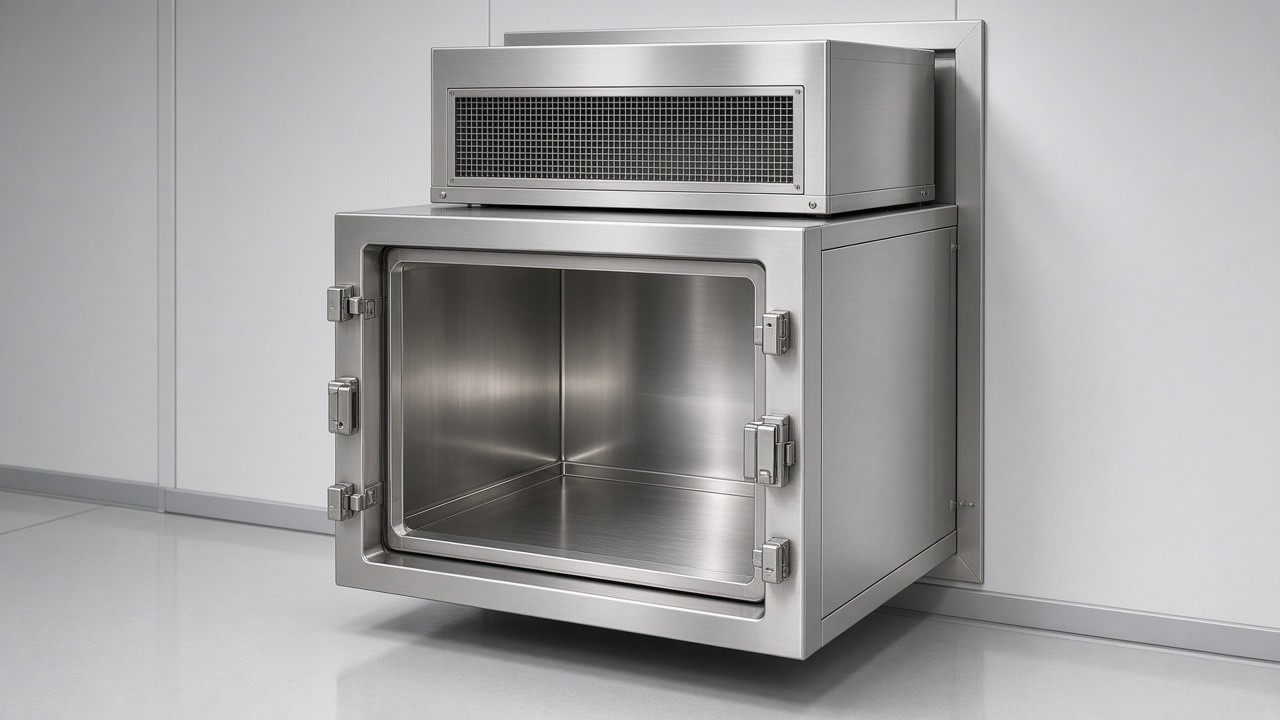
CleanroomLink supplies dynamic pass boxes for high-frequency transfer between cleanroom zones with different classifications. HEPA-filtered air circulation, pressure management, and controlled door interlocking help protect the material flow and the surrounding cleanroom process.
Transfer control
Active HEPA circulation
Configuration
Project-specific
Specification map
Start with the parameters that control your material flow
A dynamic pass box is an active airlock, not simply a stainless steel cabinet. The right selection connects airflow, room pressure, door interlocking, installation conditions, and compliance documentation.
Performance
HEPA or ULPA filtration, airflow velocity, recovery behavior, pressure monitoring, and noise requirements.
Dimensions
External footprint, clear internal aperture, largest transfer item, wall thickness, and service access.
Compliance
Target ISO classification, GMP expectations, electrical market requirements, traceability, and qualification documents.
Environment
Temperature, humidity, cleaning agents, chemical resistance, wash-down expectations, and operating conditions.
Buyer questions
Why choose a dynamic pass box?
How is particulate migration controlled?
The chamber uses active filtered air circulation and controlled door cycles to create a defined contamination control barrier between zones.
How is the pressure cascade maintained?
The airflow and pressure strategy is selected against the room-to-room differential and confirmed during project engineering.
How quickly does the chamber recover?
Recovery performance depends on chamber volume, airflow design, filter configuration, loading pattern, and the cleanliness target. It should be verified for the selected model.
Which standards apply?
The applicable ISO, GMP, electrical, and qualification requirements depend on the destination market and facility validation plan.
Short answers
The CleanroomLink advantage
Dynamic pass boxes, also called active pass boxes, use a self-contained airflow system with HEPA filtration to remove airborne contamination from the chamber. Unlike static pass boxes that rely on passive air exchange, an active unit supports a controlled transfer environment where traffic frequency and room classification make contamination risk more demanding.
- ✓Active HEPA-filtered circulation for controlled material transfer
- ✓Interlocked doors that protect the pressure cascade
- ✓Configuration support for demanding cleanroom applications
Product structure
An active barrier built around the transfer path
The design must coordinate the chamber, airflow, access points, seals, controls, and installation interface. These elements determine whether the pass box functions as part of the facility’s contamination control strategy.
Filtered air system
Integrated fan-filter units provide filtered supply air. HEPA or ULPA selection, airflow pattern, and service access are confirmed for the required cleanliness target.
Door interlocking
Electronic, electromagnetic, or mechanical interlocks prevent both doors from opening at the same time and preserve the intended material flow boundary.
Airflow distribution
The chamber layout is designed to limit dead spots and support uniform air movement around the transferred load.
Cleanable construction
SS304 or SS316L interiors with coved corners can be considered where cleaning, sterilization, chemical resistance, or material traceability is important.
Technical parameter table
Define the configuration before requesting a quote
The fields below correspond to the product structure. Final values, compatibility, certificates, and documentation must be confirmed during the RFQ and project engineering stages.
| Parameter | Configuration guidance | RFQ status |
|---|---|---|
| Type | Laminar flow or turbulent flow | Confirm by application |
| External dimensions | Custom to site layout and service access | To be confirmed |
| Internal dimensions | Based on largest container, component, or load | To be confirmed |
| Box material | SS304 or SS316L, subject to environment | Confirm material grade |
| Door interlock | Electronic, electromagnetic, or mechanical | Select control type |
| Filtration system | HEPA or ULPA; filter specification depends on target class | Confirm at RFQ |
| Airflow velocity | Adjustable; final setpoint depends on airflow design | To be confirmed |
| Pressure | Differential pressure gauge or digital monitoring | Match facility cascade |
| Disinfection option | UV-C lamp or VHP port where compatible | Available on request |
| Sealing method | Door gasket and chamber sealing strategy | Confirm cleaning protocol |
| Power supply | Regional electrical requirement and controls | To be confirmed |
| Cleanliness class | ISO Class 5 to 8 target, depending on configuration | Verify by test plan |
| Installation | Wall-mounted or floor-mounted | Confirm wall and access conditions |
Applications
Where active transfer control matters
Pharmaceutical packaging
Protect sterile component movement
Consider VHP-compatible configurations, suitable sealing, and qualification documentation for transfers into filling or packaging areas.
Semiconductor assembly
Reduce micro-contamination risk
High-control airflow and carefully selected internal clearances support tool, component, and container movement between classified areas.
Food processing
Support high-care zone transfers
Wash-down considerations, stainless steel construction, sealing, and chemical resistance should be matched to the sanitation program.
Selection boundary
Static or dynamic pass box?
The correct choice depends on room classification, pressure differential, transfer frequency, and the contamination risk associated with the material flow.
Static pass box
Generally suited to lower-frequency transfers between rooms of similar grades where pressure differentials and contamination risks are limited.
Dynamic pass box
Preferred when zones have different classifications, traffic is frequent, or active HEPA circulation and pressure control are required.
Pre-order checklist
What to verify before ordering
Wall construction
Confirm whether the unit will be installed in a sandwich panel wall, masonry, or glass partition, including available wall thickness.
Pressure cascade
Provide the pressure differential between rooms so the airflow and monitoring strategy can be calibrated to the facility.
Material size and loading
Measure the largest standard container, component, tool, or pallet and allow for safe clearance and handling.
Certification needs
Identify ISO, GMP, CE, UL, IQ/OQ, material traceability, and other regional documentation requirements before finalizing the scope.
FAQ
Answers for procurement and engineering teams
How can I confirm the correct model when some parameters are not yet available?
Send the wall thickness, largest transfer item, target room classifications, transfer frequency, pressure differential, installation location, and destination market. The model and configuration can then be confirmed during the RFQ review.
Which factors affect the price of a dynamic pass box?
Major cost drivers include chamber size, SS304 or SS316L construction, airflow and filter selection, interlock type, monitoring, disinfection options, installation interface, electrical requirements, documentation, testing, and customization.
Does CleanroomLink support custom configurations?
Custom dimensions, materials, airflow arrangements, interlocks, sealing, monitoring, installation formats, and project documentation are available on request, subject to technical review.
Does CleanroomLink provide installation support?
Detailed installation manuals and remote technical guidance are available. On-site supervision can be discussed for larger projects and site-specific requirements.
How can energy use be managed?
The selected fan and control strategy can be reviewed for energy performance and potential integration with the facility BMS. Final compatibility should be confirmed for the project.
Quote preparation
Get a Configuration Recommendation
Avoid the risks of off-the-shelf procurement. CleanroomLink helps you select the correct dimensions, airflow, filtration, interlocking, materials, and documentation before pricing is finalized.
Send your cleanroom layout, target ISO class, pressure cascade, material dimensions, transfer frequency, installation conditions, and destination market. Our technical team can review the application and provide a configuration recommendation with lead-time guidance.