
Cleanroom personnel entry systems
Gowning Stations for Controlled Personnel Flow
In the cleanroom supply chain, a gowning station is not simply furniture. It is a control point for personnel entry, contamination prevention, and SOP execution. Delayed procurement, unconfirmed dimensions, or unsuitable materials can hold up an entire facility upgrade.
CleanroomLink supports overseas buyers, engineers, quality teams, and factory managers with application-led sourcing for new builds and retrofit projects. We align the station configuration with room layout, personnel throughput, ISO classification, and audit expectations.
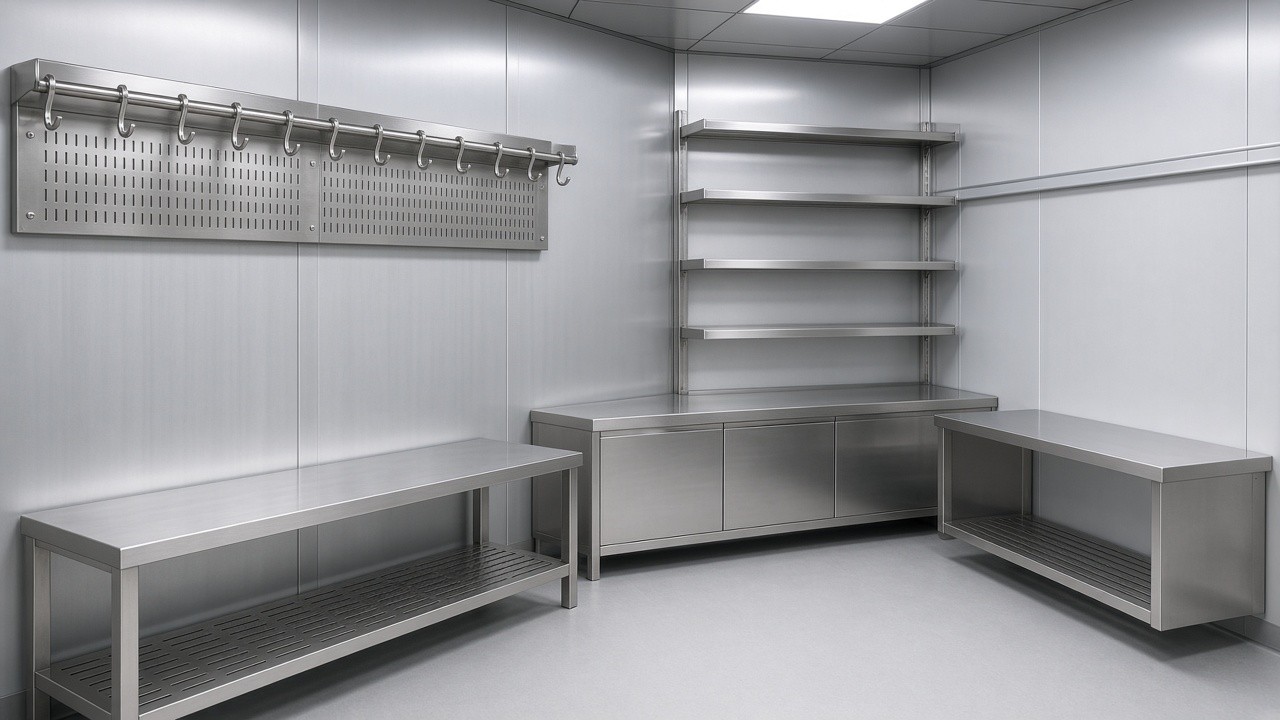
Procurement focus
Confirm footprint, MOQ, material grade, finish, lead time, and substitution risks before production release.
From Application to Spec
Design the entry point around the SOP
The transition from an uncontrolled area to a controlled environment must support the actual sequence of dressing, storage, inspection, and entry. A well-specified gowning station reduces congestion during shift changes and helps limit avoidable contamination risks.
Footprint optimization
Match width, depth, height, seating, and storage to the available gowning room layout.
SOP alignment
Support sequential or simultaneous dressing without creating a cross-flow between clean and less-controlled zones.
Material integrity
Review stainless steel grade, surface finish, cleaning chemistry, and sterilization requirements before approval.
Supply continuity
Lock critical specifications early to reduce lead-time surprises, MOQ issues, and unapproved alternative materials.
Environment Inputs
Inputs that determine the right configuration
A Gowning Stations supplier should review the operating environment before recommending a model. The following inputs affect capacity, layout, materials, and the RFQ scope.
Personnel throughput
Headcount per shift influences locker, dispenser, seating, and circulation requirements.
Workflow directionality
Single-pass or recirculating movement affects zoning between street clothes, gowning, and clean entry.
ISO classification
Surface design and cleanability should be reviewed against the intended cleanroom class.
ESD requirements
Electronics and semiconductor sites may require conductive materials, grounding points, and ESD review.
Parameter Table
Gowning Stations specifications for RFQ review
Each field can affect quotation cost, production lead time, installation scope, and compliance review. Confirm project-specific values during the RFQ stage rather than assuming a catalog default.
| RFQ field | Options and procurement considerations | RFQ status |
|---|---|---|
| Product type | Wall-mounted, freestanding, or modular integrated unit | To Be Confirmed |
| Material | SUS304 standard option or SUS316L where higher corrosion resistance is required | Confirm chemistry and grade |
| Dimensions | Custom width, depth, and height based on site conditions | Required for RFQ |
| Capacity | Defined by personnel headcount and shift-change throughput | Required for RFQ |
| Layers / compartments | Hanging rods, cubbies, shelves, or dispenser compartments | Depends on Model |
| Door lock method | Applicable lock configuration depends on the storage module and access policy | Available on Request |
| Casters / fixing | Adjustable leveling feet, casters, or floor-anchored installation | Confirm floor requirements |
| Surface treatment | Brushed finish or electropolished finish, subject to application review | Confirm cleaning regime |
| Cleanroom grade | Design target may range from ISO 5 to ISO 8 depending on application | Confirm site standard |
| ESD option | Conductive materials, coatings, and grounding points may be available | Available on Request |
| Installation method | Freestanding placement, wall mounting, or floor anchoring | Confirm site constraints |
| Customization | Pass-through interfaces, mirrors, glove dispensers, lighting, and integrated benches | Custom |
Material grade, dimensions, load requirements, anchoring, finish, ESD needs, and any requested documentation should be confirmed before order release.
Configuration Logic
Build the station around personnel entry
Our configuration process connects the station to the room zoning and the actual dressing sequence, rather than treating each component as an isolated SKU.
- 1
Zone the room
Separate the less-controlled side from the clean side and define the intended direction of movement.
- 2
Place storage and dispensing
Position garment, mask, glove, or accessory dispensers where they support the approved gowning sequence.
- 3
Add seating and inspection
Use cleanroom-suitable benching for boot or shoe-cover changes and consider lighting for a final visual check.
- 4
Review installation
Confirm access, anchoring, leveling, service interfaces, and maintenance clearance before fabrication.
Applications and Validation
Where the configuration matters most
Typical industries
- Pharmaceutical and biotechnology: easy-to-sanitize designs for controlled and sterile environments.
- Medical devices: stainless steel configurations selected to limit particulate concerns.
- Electronics and semiconductor: ESD-safe materials and grounding configurations where required.
- Precision manufacturing: durable, high-capacity stations for demanding operational areas.
Validation points for QA and compliance
- Material traceability and mill test reports for the selected stainless steel grade.
- Surface integrity and roughness documentation where required for cleaning or sterilization review.
- Chemical-resistance information for disinfectants such as IPA or VHP, subject to the selected finish.
- Alignment review against applicable cleanroom construction, GMP, EHS, or local standards.
Specific certificates, test reports, and standards documentation are available on request and must be confirmed in the RFQ.
Alternative Options
Standard or custom: choose by application boundary
A standard gowning station is often the better choice for repeatable layouts and shorter procurement cycles. Custom engineering becomes relevant when room geometry, throughput, sterile handling, or integration requirements cannot be met by a pre-engineered unit.
Standard solution
Cost and lead-time focused
Pre-engineered units for general ISO and GMP environments, subject to model availability and final specification confirmation.
- Suitable for repeatable room layouts
- Efficient path for wholesale or multi-unit projects
- Fewer design iterations before production
Engineered solution
Integration and performance focused
Designed for unusual footprints, higher throughput, special materials, ESD needs, sterile requirements, or integrated room interfaces.
- Custom dimensions and storage logic
- Application-specific material and finish review
- Value engineering to avoid unnecessary over-specification
FAQ
Questions buyers ask before approval
Which material should we select?
SUS304 may suit many standard applications, while SUS316L can be considered where corrosion resistance or aggressive cleaning chemistry is a concern. The final grade depends on the environment and must be confirmed during RFQ.
Can the stations be ESD safe?
Yes. Conductive materials, coatings, and grounding points may be available for electronics and semiconductor applications. ESD requirements and verification scope should be stated in the inquiry.
What storage conditions should we plan for?
Storage layout depends on garment type, headcount, shift pattern, and gowning SOP. Hanging rods, cubbies, shelves, and dispenser compartments are available depending on the model.
What affects service life?
Material grade, surface finish, cleaning frequency, disinfectant chemistry, loading, and installation conditions all influence service life. A fixed lifespan should not be assumed without application data.
Can we validate a sample before a larger order?
Single-unit orders and pilot projects may be supported. Sample validation can review dimensions, workflow, finish, storage access, and compatibility with the site SOP before wholesale deployment.
Are custom stations compatible with VHP?
316L and specialized finishes may be considered for VHP or other aggressive decontamination agents. Compatibility depends on the complete material and finish specification and should be documented in the RFQ.
Submit Application Details
Compare Options for your gowning area
Tell us your budget, target standards, and operating conditions. We will review the application and return two procurement paths: a cost-optimized Standard Solution and a performance-optimized Engineered Solution.
- Project scope: new build or facility upgrade
- Capacity: personnel passing through per shift
- Constraints: available length, width, height, and floor restrictions
- Compliance: ISO class, GMP, ANSI, ESD, or other target standards
- Budget and timeline: milestone dates and purchasing expectations
Request your two-option recommendation
Share drawings, layout constraints, material preferences, or existing SOP information where available.